

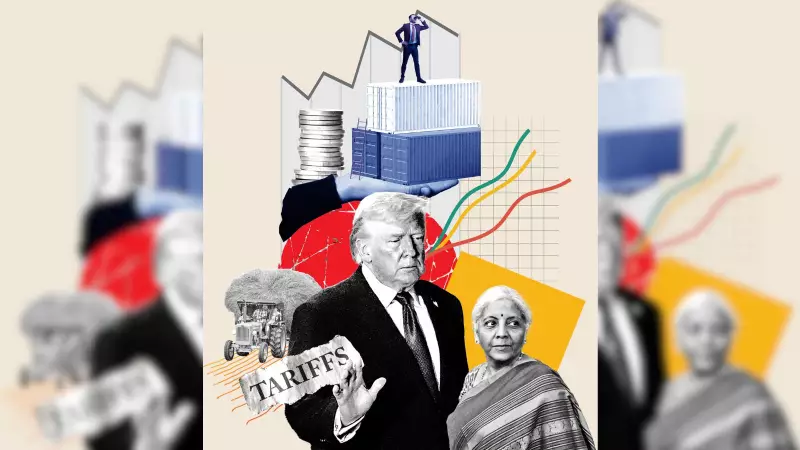
As 2025 draws to a close, the Indian economy presents a classic paradox, simultaneously confounding its optimists and pessimists. The world's fourth-largest economy is finishing the year with a robust set of macroeconomic indicators, including controlled inflation and low interest rates. However, significant challenges loom on the horizon, primarily from external factors like persistent US tariffs and the disruptive force of artificial intelligence, while the domestic imperative to revive consumption demand remains the government's central task for 2026.
The Tariff Onslaught and India's Unexpected Resilience
The year began with policymakers in New Delhi hopeful that India would escape the worst of former President Donald Trump's tariff offensive and secure an early trade deal with the United States. Nearly twelve months later, both expectations have been upended. India now contends with the highest effective tariffs for its exports entering the US market, surpassing even those faced by China, and a bilateral trade agreement seems a distant prospect.
The Trump administration's imposition of a 25% reciprocal tariff, compounded by an additional 25% penalty linked to India's purchase of Russian crude, sparked fears of a stalled export engine. A simultaneous clampdown on H-1B visas threatened a dual blow to both goods and services exports. Contrary to these dire predictions, India's exports to the US showed a resilient uptick in November 2025, recovering from a decline through September. This recovery was fueled by strong performance in tariff-exempt sectors like pharmaceuticals and electronics, alongside successful efforts by exporters to diversify into alternative markets.

Domestic Reforms and Macroeconomic Stability
On the home front, Indian businesses registered steady growth through recent quarters. The National Democratic Alliance (NDA) government, defying post-2024 election perceptions of reform fatigue, used the external crisis as a catalyst for a series of significant policy moves in the latter half of the year.
These included long-pending adjustments to Goods and Services Tax (GST) rates, progress on stalled labour law reforms, and amendments to nuclear sector regulations aimed at attracting private and foreign investment—albeit with diluted supplier liability clauses. A suite of financial services reforms, permitting 100% foreign ownership in insurance and new investment rules for banks and pension funds, aimed to attract foreign capital amid concerns over outflows and a widening current account deficit (CAD).
Other notable actions involved scaling back the rural employment guarantee scheme (MGNREGA) and revoking restrictive Quality Control Orders (QCOs) that had burdened smaller companies. A late-year surge in Foreign Direct Investment (FDI), anchored by major commitments from tech giants like Google, Amazon, and Microsoft in cloud and AI infrastructure, helped alleviate capital flow worries. A managed depreciation of the Indian rupee, now trading above 90 to the US dollar, also serves as a partial buffer against high American tariffs.
2026 Outlook: Growth Amidst Persistent Headwinds
India retains its status as the world's fastest-growing major economy, with GDP forecast to expand by 7.3% in fiscal year 2026. Chief Economic Adviser V. Anantha Nageswaran, in a November 29 briefing, expressed confidence that full-year growth for 2025-26 would be "at least 7 per cent." Domestic tailwinds such as healthy agricultural prospects, the ongoing benefits of GST rationalisation, low inflation, and strong corporate balance sheets are expected to support activity.
However, global tariff shocks will continue to cast a shadow. While the immediate impact has been less severe than feared, uncertainty persists. Axis Capital, in its 2026 Outlook, notes that growth headwinds from fiscal and monetary tightening have abated, leading to a revival. The firm projects monetary easing could drive growth to 7.5% in FY27.

On the external front, challenges are mounting. J.P. Morgan's Chief India Economist, Sajjid Z. Chinoy, points out that while the AI boom in the US is currently masking some tariff effects, a weakening American labour market and rising US inflation will make the tariffs bite. Furthermore, the US trade blockade on China risks diverting Chinese exports to other markets, including India, flooding them with goods and creating competitive pressures for local industries.
India's services exports, having grown its global market share from 2% to 4.5% in under a decade, remain a bright spot. Tighter immigration policies in the West are paradoxically benefiting India by forcing more remote work to its shores. Yet, questions remain about the value addition happening within the country's Global Capability Centres.
The Central Challenge: Igniting Consumption to Fuel Investment
The most critical domestic hurdle identified is reviving consumption demand to stimulate private investment—a persistent struggle for the government. Corporate leaders privately emphasise that demand visibility is essential for committing to new investments. Capacity utilisation, currently in the 75-77% range, needs to sustain around 80% for several quarters to justify greenfield projects.
Both high-end urban consumption and government spending, which have propelled the economy since the pandemic, are now waning. With exports forecast to be sluggish, stoking private investment becomes an imperative alternative engine for growth. A World Bank report from February 2025 underscored the scale of the challenge, stating India must average 7.8% growth over the next 22 years to achieve high-income status by 2047.
As the year wraps up, pivotal questions define the road ahead. The potential for a US recession, the sustainability of the AI-driven stock market exuberance, and the legal fate of US tariffs (currently before the American Supreme Court) are key external variables. Domestically, the success of new labour codes and broader efforts to harness India's demographic dividend will be crucial in ensuring that the benefits of growth are shared more equitably between capital and labour.





