

India Pauses Proposed LPG Rationing Plan as West Asia Tensions Show Signs of Easing
The central government has instructed state-run oil marketing companies (OMCs) to proceed cautiously with a proposed plan to supply reduced quantities of domestic LPG cylinders. This decision comes amid easing geopolitical tensions in West Asia and reports of an apparent ceasefire that could potentially stabilize global energy supplies.
Background: The Proposed Rationing Measure
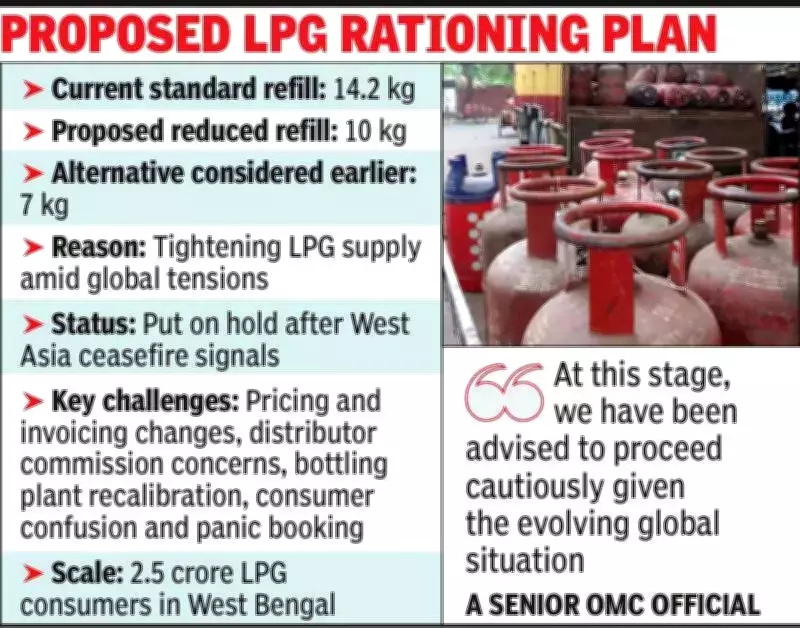
The Ministry of Petroleum and Natural Gas had earlier directed India's three major public sector oil companies – Indian Oil Corporation (IOC), Bharat Petroleum Corporation Limited (BPCL), and Hindustan Petroleum Corporation Limited (HPCL) – to explore the feasibility of supplying 10 kg of LPG in standard 14.2 kg cylinders. This was intended as a temporary rationing measure during a period of tightening global supplies.
Officials revealed that the ministry had even considered a more drastic 7 kg option before settling on the 10 kg proposal. "Companies were asked to examine operational feasibility, and the feedback was it can be implemented within a day or two if required," explained a senior OMC official familiar with the discussions.

Changing Geopolitical Landscape
With geopolitical conditions showing signs of improvement in West Asia, the urgency behind the rationing proposal has diminished, at least temporarily. "At this stage, we have been advised to proceed cautiously given the evolving global situation," the OMC official added, highlighting how international developments directly impact domestic energy policies.
The decision reflects how India's energy security remains vulnerable to global conflicts, particularly in oil-rich regions like West Asia where recent tensions between Israel, Iran, and the United States had threatened to disrupt energy flows.
Persistent Supply Concerns and Technical Challenges
Despite the temporary pause, significant concerns about LPG supply continue to loom. Industry executives warn that availability could deteriorate over the coming month, leaving policymakers with limited options if domestic demand begins to outpace supply.
Distributors have identified several substantial technical and financial obstacles to implementing any reduced-fill plan:
- Recalibration requirements: Bottling plants would need significant adjustments to handle different cylinder quantities
- Systemic changes: Invoicing systems and pricing structures would require comprehensive modifications
- Customer confusion: "A large number of customers have already made online payments for 14.2 kg cylinders," noted a Kolkata-based LPG distributor. "Adjusting that to 10 kg will create confusion and require system-wide changes."
Economic Implications for Distributors and Consumers
The proposed changes would have significant economic consequences throughout the supply chain. "The effort involved in delivering a cylinder remains the same whether it contains 10 kg or 14.2 kg," explained a Bharat Gas dealer. "If commissions are reduced proportionately, distributors may resist the move."
Transportation costs present another challenge, as vehicles would need to make more frequent trips to deliver the same total quantity of LPG to consumers.
Consumers have expressed apprehension about the potential changes. "If the quantity is reduced, even with a price cut, it means more frequent bookings and uncertainty about availability," said Anup Chander, a resident of Kolkata's Behala neighborhood. "People may panic and start hoarding."
Government Measures to Prevent Panic Buying
To address concerns about panic booking, the government had previously implemented a 25-day gap between LPG deliveries and subsequent bookings. This measure aims to prevent stockpiling and ensure more equitable distribution during periods of potential scarcity.
Political Sensitivity and Implementation Timing
OMC officials have cautioned that any sudden rollout of reduced cylinder quantities could trigger public confusion and backlash, particularly with key state elections approaching. "Any visible reduction in cylinder quantity could become a sensitive issue," an executive noted, highlighting how energy policies often intersect with political considerations in India.

The current pause allows for continued monitoring of global energy markets while maintaining domestic stability in LPG distribution – a crucial commodity for millions of Indian households that rely on it for cooking fuel.





