

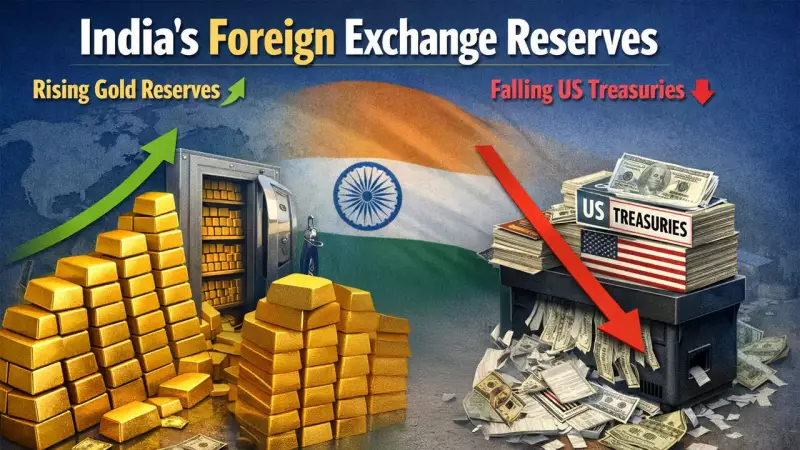
India's US Treasury Holdings Hit Five-Year Low in Major Strategic Shift
In a significant development for one of the world's top five economies, India's investments in US Treasury securities have plunged to their lowest level in five years. This substantial reduction reflects a dual strategy driven by both immediate economic necessities and long-term strategic recalibration of the country's foreign exchange reserves.
The Numbers Behind the Decline
Recent US government data reveals that India's holdings of long-term American debt have dropped to approximately $174 billion. This represents a dramatic 26% decrease from the peak levels recorded in 2023. According to the Reserve Bank of India, Treasury securities now constitute roughly one-third of the nation's total forex reserves, down significantly from around 40% just a year ago.
Strategic Diversification Away from Dollar Assets
The primary motivation behind this shift appears to be a strategic effort to reduce dependence on US dollar-denominated assets. This move aligns India with a broader global trend where numerous economies are reassessing their reliance on the world's largest bond market. As Win Thin, chief economist at Bank of Nassau 1982 Ltd., observed, "The trend likely reflects an effort to cut dependence on dollar-denominated assets to reduce sanction-related risks."

Finance Minister Nirmala Sitharaman confirmed in September that the RBI was making "a very considered decision" to diversify the country's reserves portfolio. This strategic rethinking has been influenced by recent geopolitical events, particularly the US decision to freeze Russia's foreign exchange reserves following the Ukraine conflict that began in February 2022.
Rupee Depreciation and Trade Tensions
Another crucial factor driving India's Treasury sell-off is the persistent depreciation of the rupee, which ranked among Asia's worst-performing currencies last year. The RBI has been actively intervening to support the currency, which has slipped to record lows amid delayed trade negotiations with the United States.
Trade relations between the two nations deteriorated significantly last year, with the Trump administration imposing 25% additional penal tariffs on certain Indian exports and threatening even higher rates. Shilan Shah of Capital Economics noted, "The speed at which relations between the US and India deteriorated last year would have taken many by surprise and jolted policymakers to reduce their vulnerabilities."
By reducing US Treasury holdings, the central bank can redeploy those funds to purchase rupees in the open market, thereby providing support for the struggling currency.
The Global Context and Gold's Rising Appeal
India's strategy mirrors actions taken by other major economies. According to a Bloomberg report, China and Brazil have similarly reduced their long-term Treasury holdings to their weakest levels since at least 2011. Concurrently, these nations have been increasing their gold reserves, with China actively stepping up purchases of the precious metal.
India itself has been boosting its gold holdings and currently possesses the world's seventh largest gold reserves. This shift toward alternative assets is gaining momentum globally, with the National Bank of Poland recently announcing plans to add another 150 tonnes of gold to its reserves.
Future Outlook and Market Implications
While several factors could potentially slow India's pace of Treasury sales—including a more stable rupee or the conclusion of a delayed trade agreement—analysts believe the broader reallocation toward alternative assets is likely to continue. Krishna Bhimavarapu, Asia Pacific economist at State Street Investment Management, suggested, "If the trade deal materializes, the need for aggressive currency defense could diminish."
However, Michael Brown, senior research strategist at Pepperstone in London, emphasized that the trend is firmly established, noting that any trade agreement "will simply see holdings stabilize, rather than India go on some sort of mass buying spree."

The movement away from US Treasuries has reignited debates about American financial dominance and the safety of dollar-denominated assets as preferred reserve instruments. A November survey by think tank OMFIF revealed that while most central banks still hold dollars, nearly 60% intend to explore substitutes over the next one to two years.
Although India's Treasury holdings represent only about a quarter of China's nearly $683 billion portfolio and a fraction of Japan's $1.2 trillion holdings, the country's selling has added fresh momentum to discussions about the future role of US sovereign bonds in global investment portfolios.





