

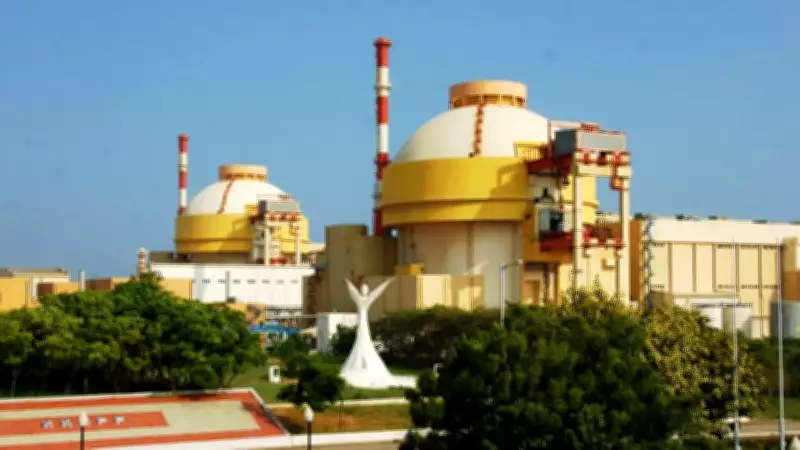
India Moves Closer to Opening Nuclear Sector to Foreign Investment
India has taken a significant step toward opening its nuclear power sector to foreign investment, with the Atomic Energy Commission officially approving a new foreign direct investment framework. This development marks a crucial policy shift aimed at mobilizing substantial capital for the country's ambitious nuclear energy expansion plans.
Policy Approval and Ministerial Consultations
Speaking at a recent workshop in Delhi, Seema S Jain, member (finance) from the Department of Atomic Energy, confirmed that the Atomic Energy Commission has given its approval to the FDI policy. The framework is now proceeding to ministerial consultations before final implementation, representing a major advancement in India's nuclear energy strategy.
Jain emphasized that this policy forms part of a comprehensive effort to secure massive financing for increasing nuclear energy capacity across the nation. The move comes as India faces the challenge of meeting its substantial energy needs while transitioning toward cleaner power sources.

Ambitious Capacity Targets and Investment Requirements
India has established an ambitious target of increasing its nuclear power capacity to 100 gigawatts by 2047, which represents a substantial expansion from current levels. Achieving this goal will require massive investment estimated at up to Rs 20 lakh crore, necessitating significant participation from foreign investors and private sector entities.
The proposed FDI policy receives strong support from the recently-enacted SHANTI Act 2025, which was officially notified on December 21 last year. This legislation provides a coherent legal framework with enabling provisions for private sector participation in nuclear energy research, innovation, and development under strict licensing and safety authorization protocols.
Fleet Mode Approach for Accelerated Development
Officials have highlighted the advantages of adopting a fleet mode approach to nuclear reactor development, where multiple reactors would be constructed simultaneously at single sites. This strategy aims to significantly speed up approval processes and construction timelines, making nuclear power projects more efficient and cost-effective.
The Department of Atomic Energy recently explained that the historically slow expansion of nuclear power capacity in India resulted from multiple factors, including an initial technology development phase that faced international embargoes and technology denial regimes, coupled with limited availability of financial and technical resources.
Challenges in Private Sector Participation
Despite these policy advancements, NTPC has experienced lower-than-expected interest from private companies in nuclear power projects, indicating ongoing challenges in attracting outside capital to the sector. This underscores the importance of the new FDI framework in creating a more attractive investment environment for both domestic and international players.
The comprehensive approach combining the FDI policy with the SHANTI Act 2025 aims to address these challenges by providing clear regulatory pathways and investment security for foreign entities interested in participating in India's nuclear energy expansion.






