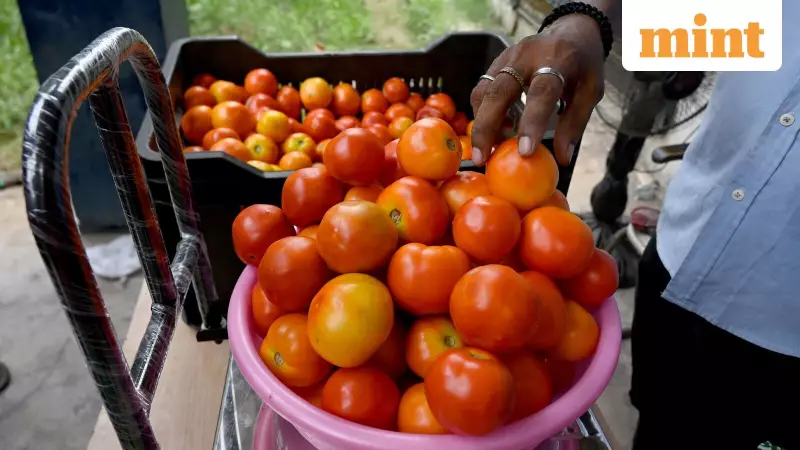
Government Steps In to Cool Tomato Prices After Cyclone Damage
The Indian government has initiated the sale of subsidized tomatoes in the national capital at ₹52 per kilogram and plans to extend this operation to other parts of the country. This decisive move aims to control the sudden price surge triggered by extensive crop damage caused by cyclone Montha last month, according to two government officials familiar with the matter.
Retail tomato prices have skyrocketed beyond ₹80 per kg in several areas of Delhi after the cyclone devastated key growing regions in Andhra Pradesh and Karnataka, severely disrupting supply chains. The Ministry of Consumer Affairs, Food and Public Distribution has authorized the sale of "Janata" brand tomatoes at ₹52 per kg through the National Cooperative Consumers' Federation of India (NCCF).
Unusual November Intervention Signals Serious Supply Crisis
This market intervention marks an unusual development for November, as large-scale tomato and onion operations typically occur between August and October when seasonal shortages peak due to monsoon rains. The government's action comes just ahead of the winter session of Parliament, scheduled from December 1 to December 19.

Supplies to Delhi, Haryana, and Uttar Pradesh have tightened significantly in recent days, pushing both wholesale and retail prices upward. The first official explained that heavy rains and powerful winds from cyclone Montha have severely damaged tomato crops, creating the current supply crisis.
According to the agriculture ministry's third advance estimates for 2024-25, India's tomato production is expected to decline sharply to 19.46 million tonnes from 21.32 million tonnes the previous year. Andhra Pradesh and Karnataka account for approximately 16% and 10% of national production respectively.
Key Production Belts Suffer Significant Damage
The Madanapalle region of Chittoor district in Andhra Pradesh and the Kolar-Chikkaballapur belt in Karnataka—two of India's most influential mandis for hybrid tomatoes—have reported substantial crop damage and reduced market arrivals.
"We keep track of the prices of all essential commodities and intervene as and when required," stated the second government official. "Though tomato arrivals typically remain normal during this period, the damage to crops in key producing areas has reduced supply and created market disruption. The sale of Janata tomatoes will continue until prices stabilize in the ₹40-50 per kg range."
The subsidized tomatoes will be available through mobile vans and counters across prominent Delhi-NCR locations including Krishi Bhawan, Barakhamba Road, Khari Baoli, Saket, Malviya Nagar, Patel Chowk, R.K. Puram, Nehru Place, Rohini, Dwarka, and Noida.
In a parallel move, NCCF will also sell onions at ₹15 per kg at various locations across Delhi-NCR, providing additional relief to consumers facing rising food prices.
Farmers Bear the Brunt of Natural Calamity
Farmers in affected regions express deep concern about their financial situation. "We were expecting a good harvest, but the rains have spoiled the yield," lamented Sadashiv Halur, a farmer from Mulbagal taluka in Karnataka's Kolar district. "Since input costs have already risen, it will be difficult for small and marginal farmers to repay their loans."
According to a senior horticulture official in the Karnataka state government, approximately 765 hectares of tomato crops suffered damage due to unseasonal rain. The total area under tomato cultivation in Karnataka stands at 39,474 hectares.
Experts Highlight Structural Vulnerabilities
Agricultural policy expert Pravesh Sharma, former managing director of Small Farmers' Agribusiness Consortium, emphasized the inherent volatility in tomato markets. "Tomato is one of the most volatility-prone vegetables, and even small disruptions in Andhra Pradesh or Karnataka can trigger sharp retail spikes in the north. This intervention will help stabilize prices short-term, but the larger issue remains our dependence on a few belts like Madanapalle and Kolar."
Sharma stressed that India must invest in distributed production clusters and better storage infrastructure to prevent such price swings from recurring annually.

Price Data Reveals Alarming Trends
Consumer affairs ministry data reveals that retail tomato prices in Delhi reached ₹80 per kg on November 25, representing a staggering 66.7% increase from ₹48 per kg recorded a year earlier. Similar patterns emerged across other metropolitan cities, with Kolkata witnessing a 40.4% year-on-year increase to ₹73 per kg and Chennai experiencing an 87.5% surge to ₹75 per kg.
Interestingly, wholesale prices have remained relatively stable despite the dramatic retail increases. Wholesale tomato prices stood at ₹4,182.21 per quintal on November 25, up only 0.53% from ₹4,160.21 per quintal a year ago. This significant gap indicates that retail margins have widened considerably even though mandi prices have barely moved.
Economic and Political Implications
Abhash Kumar, assistant professor of economics at Delhi University, noted that "with tomatoes carrying a weight of about 0.6% in the Consumer Food Price Index, even a brief spike can introduce short-lived volatility, though headline inflation remains broadly contained."
B.B. Singh, former assistant director general of the Indian Council of Agricultural Research, observed that "the early intervention reflects the government's concern that even a temporary spike in tomatoes—given their weight in the consumer food basket—can attract political criticism during the Parliament session. The Centre is expected to monitor supplies closely until arrivals normalize in December."
Market Outlook and Future Expectations
Amar Thakur, proprietor of Roop Lal & Sons, a wholesale trader in Himachal Pradesh's Solan district, provided some optimism: "Currently, we are getting tomatoes from Nashik, and supply is short because of crop failure. However, prices are expected to ease over the next 20-25 days as fresh arrivals from Rajasthan and Punjab begin entering the market."
This marks the government's third intervention to control tomato prices in 2024. The first operation occurred in July when retail rates touched ₹80-100 per kg, with discounted tomatoes sold at ₹60 per kg. A second round followed in October when average market prices hovered around ₹100 per kg and subsidized tomatoes were available at ₹65 per kg.
In 2023, tomato prices had surged past the ₹250 mark, prompting the government to sell tomatoes at ₹90 per kg in August. As market prices eventually cooled, the subsidized rate was reduced to ₹40 per kg.
The current initiative represents the government's proactive approach to managing essential commodity prices while addressing both immediate consumer concerns and longer-term agricultural challenges.