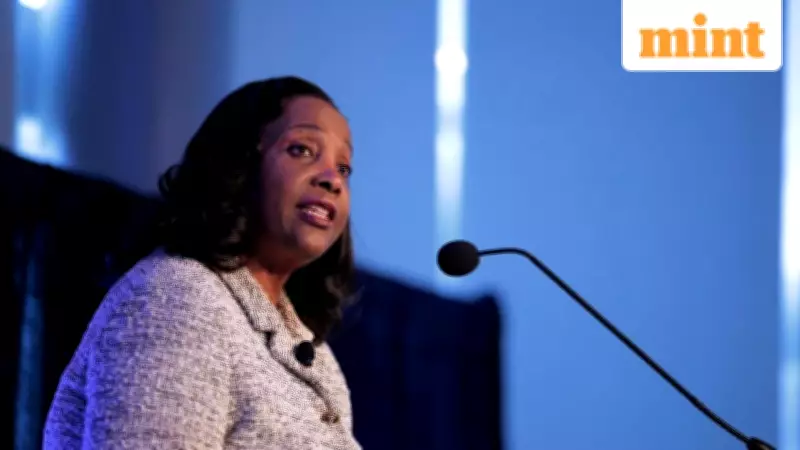
Federal Reserve Governor Lisa Cook has articulated a clear stance that elevated inflation poses a more significant threat to the United States economy than a weakening labor market. This perspective suggests she may be hesitant to support a return to interest rate cuts in the near future, emphasizing the central bank's ongoing battle against persistent price pressures.
Inflation Remains the Primary Focus
Speaking at an economists' club event in Miami on Wednesday, Cook acknowledged the economy's resilience but highlighted that inflation continues to run above the Fed's 2% annual target. She cautioned against premature optimism regarding cooling price increases, stating it is too soon to take comfort in recent trends.
"After nearly five years of above-target inflation, it is essential that we maintain our credibility by returning to a disinflationary path and achieving our target in the relatively near future," Cook emphasized in her prepared remarks.

Labor Market Assessment
While recognizing that the labor market has shown signs of slowing, Cook described conditions as still solid for most American workers. She indicated that her focus will remain firmly on inflation "in the absence of unexpected changes in the labor market," suggesting that moderate labor market weakness alone wouldn't justify monetary policy easing.
Implications for Monetary Policy
Cook's hawkish stance on inflation could influence the Federal Reserve's approach to interest rates in coming months. The central bank implemented three consecutive rate cuts in late 2025, bringing the target range to 3.5%-3.75%, then maintained steady rates in January 2026.
If most Fed officials share Cook's assessment, the institution may prove reluctant to resume rate cuts despite market expectations. At the end of 2025, median Fed projections indicated one additional rate cut for 2026, but Wall Street traders anticipate further easing only later in the year, as reflected in interest-rate futures markets.
Leadership Transition Uncertainty
The Federal Reserve faces additional uncertainty due to an impending leadership transition. President Trump recently announced plans to nominate former Fed governor Kevin Warsh to succeed Jerome Powell as chair when Powell's term concludes in May.
In a television interview with NBC, Trump explicitly stated he wouldn't have selected Warsh if the nominee didn't align with the president's preference for lower interest rates. This comment highlights ongoing political pressures on Fed independence.
Political Controversy Surrounding Cook
Cook's position at the Fed has been subject to political controversy. The Trump administration attempted to remove her in August 2025 after an official accused her of filing misleading documents in personal mortgage applications before joining the central bank—allegations Cook has consistently denied.
The Supreme Court heard arguments last month regarding the administration's appeal to overturn a lower court order keeping Cook at the Fed pending litigation. Cook did not address these legal proceedings in her Miami remarks, which were scheduled for 6:30 p.m. ET, followed by a moderated question-and-answer session.
Cook's steadfast focus on inflation control, despite political pressures and labor market considerations, underscores the complex balancing act facing Federal Reserve policymakers as they navigate economic uncertainties and maintain institutional credibility.