

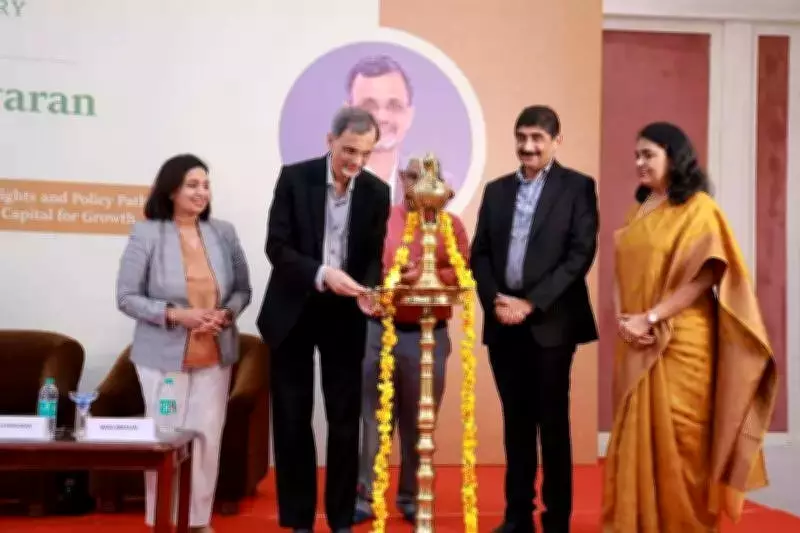
Chief Economic Adviser Advocates for Strategic Swadeshi in Changing World Order
In a significant address in Kochi, Chief Economic Adviser to the Union Government, V Anantha Nageswaran, underscored the heightened relevance of a "swadeshi" or self-reliant approach within India's economic framework, given the evolving global landscape. Speaking as the chief guest at a discussion titled 'Investing in India's Future in a Changing World Order', hosted by the Cochin Chamber of Commerce and Industry on Tuesday, Nageswaran articulated that this year's Union Budget incorporates several provisions aligned with this strategic shift.
Navigating Global Challenges with Intelligent Self-Reliance
"We have to do swadeshi this time because the world context has changed. We must execute it more intelligently than during the 1980s and since Indian independence," Nageswaran asserted. He elaborated that the necessity for this approach stems from current international dynamics, including geopolitical tensions and economic uncertainties.
Addressing potential economic pressures, Nageswaran cautioned that rising global oil prices could exert strain on the Indian rupee. However, he proposed a mitigation strategy involving the distribution of higher oil price burdens between consumers and the government, while simultaneously fostering an environment conducive to capital inflows. "These pressures are partly a function of external environments and the choices we make in allocating price increases across different system constituents," he explained.

Growth Projections and the Impact of Global Conflicts
Nageswaran noted that India's projected growth rate of 7-7.4% for the current financial year remains subject to variation, heavily influenced by the duration and intensity of ongoing global conflicts. He emphasized that while external factors pose risks, domestic policy adjustments can help cushion their effects.
Artificial Intelligence as a Transformative Force in Education
On the role of technology, Nageswaran highlighted that physical, human-centric work will continue to be a primary growth driver over the next decade, a focus reflected in the Budget. He described artificial intelligence (AI) as a pivotal opportunity to revolutionize India's education system.
"AI provides a crucial opening for us to reimagine the education system, which we haven't done in the last 80 years. We should view AI as a positive disruptor to move away from inflexible structures and create opportunities where learning becomes a lifelong process," he stated, advocating for its integration to foster adaptability and continuous skill development.
Energy Diversification and Macroeconomic Resilience
Nageswaran also stressed the importance of energy diversification, warning against over-reliance on renewable transitions alone. He pointed out that sustainable energy sources like solar power can be costly and often depend on imported components and technology. Citing global trends, he mentioned that European nations are reassessing their energy transitions due to escalating industrial costs and diminishing competitiveness.
Highlighting India's robust economic indicators, Nageswaran awarded the country's performance an A+ rating. Key achievements include:
- Accelerating GDP growth projected for FY26
- Declining inflation rates
- A fiscal deficit narrowing to 4.4% of GDP
- Foreign exchange reserves rising to $723.6 billion since FY15
- Expansion of the income tax base to 9.2 crore payers
Budgetary Focus and Support for MSMEs
Regarding the Union Budget, Nageswaran detailed a six-fold increase in public capital expenditure since FY15, coupled with strategic investments in frontier sectors such as semiconductors and nuclear energy. He also outlined a three-pronged support strategy for Micro, Small, and Medium Enterprises (MSMEs), focusing on:
- Equity enhancement
- Liquidity provision
- Professional assistance
The event was chaired by Cochin Chamber of Commerce and Industry president Vinodini Sukumar, facilitating a dialogue on India's economic trajectory amidst global shifts.






