

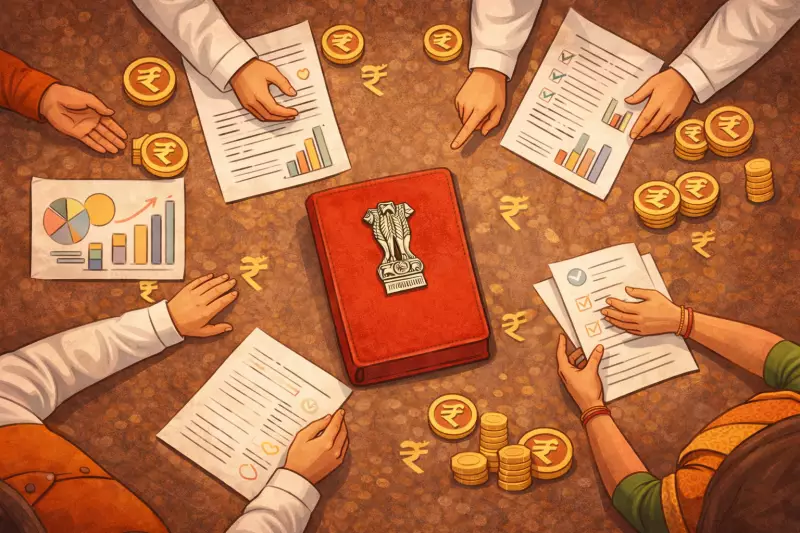
Union Finance Minister Nirmala Sitharaman is poised to present Budget 2026 for the ninth consecutive time, with anticipation building among taxpayers, businesses, and stakeholders across India. As the nation awaits the unveiling of her iconic red Bahikhata, many remain unaware of the extensive, meticulous groundwork that goes into crafting this crucial financial document.
The Journey from Plans to Bahikhata: Crafting Union Budget 2026–27
The process for Union Budget 2026–27, scheduled for presentation on February 1, 2026, began months earlier, involving a complex web of consultations, calculations, and policy refinements. Far more than a mere financial statement, the Union Budget serves as a reflection of India's economic performance over the past year and outlines the government's aspirations for the upcoming fiscal period from April 1 to March 31. It details expected expenditures, revenue projections, and policy priorities, making it a cornerstone of national economic planning.
The Intricate and Carefully Sequenced Preparation Process
In simple terms, a budget plan estimates costs and revenues over a specific timeframe. However, its preparation is an intricate, carefully sequenced endeavor that typically commences around August or September, nearly six months before Budget Day. The first formal step involves the budget division of the Ministry of Finance issuing a circular to ministries, departments, state governments, Union Territories, and public-sector bodies. These guidelines request departments to submit their projected revenue estimates and expenditure demands for the upcoming financial year, accompanied by an analysis of past spending and receipts.

Officials from various departments then compile detailed projections to help determine the likely fiscal deficit. At this stage, the Chief Economic Advisor plays a pivotal role by guiding the government on the broader economic outlook and fiscal policy decisions. Following this, proposals undergo rigorous review and intense discussions to ensure alignment with the government's overall fiscal plan.
Resource Allocation and Stakeholder Consultations
Once figures are examined and approved, they are forwarded to the Ministry of Finance, which allocates resources across ministries and sectors. In cases of disagreement over fund allocation, matters may be referred to the Union Cabinet or the Prime Minister for resolution. The process also encompasses extensive consultations with a diverse range of stakeholders. Through the Department of Economic Affairs and the Department of Revenue, discussions are held with business owners, farmers, economists, foreign institutional investors, and other interest groups to incorporate the varied needs of the economy.
A key component of this exercise is the series of pre-Budget meetings led by the Finance Minister. These include consultations with state finance ministers, industry bodies such as FICCI, CII, ASSOCHAM, and NASSCOM, startups, farmers' organisations, trade unions, NGOs, top economists, and think-tanks. The feedback gathered during these sessions helps shape spending priorities and policy measures, ensuring a balanced approach to economic governance.
Finalizing the Budget and the Traditional Halwa Ceremony
By January, following these consultations, expenditure ceilings for each ministry are finalized by the Finance Minister in consultation with the Prime Minister's Office. The Revenue Secretary then presents the final fiscal deficit calculations, after which the Union Cabinet grants its approval. The Budget enters its final phase with the traditional halwa ceremony, marking the commencement of printing the Budget papers. From this point onward, officials involved remain under strict confidentiality until the Budget is presented in Parliament.
Prepared under Article 112 of the Constitution, the Union Budget is the government's annual statement of expected income and spending. On February 1, the Finance Minister will table it in the Lok Sabha, laying out revenue plans, spending priorities, and key reforms for 2026–27. As expectations run high, understanding this behind-the-scenes process underscores the significance of Budget 2026 in shaping India's economic trajectory.






