

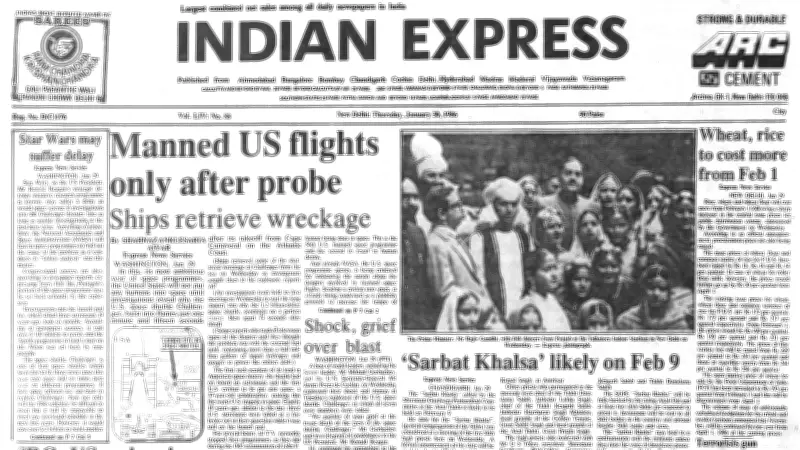
Flashback to January 30, 1986: A Day of Significant Announcements
Four decades ago, on January 30, 1986, the front page of The Indian Express carried several crucial stories that reflected the economic, social, and geopolitical landscape of the time. This historical snapshot reveals government actions on food prices, narcotics control, healthcare reforms, and international space program concerns.
Food Prices Set to Rise for Public Distribution System
In a move affecting millions of households, the government announced that rice, wheat, and wheat flour would become more expensive starting February 1, 1986. This increase followed a sharp rise in the central issue prices for the public distribution system (PDS).
According to official announcements, procurement prices were also being raised simultaneously. Specifically, the issue prices saw significant hikes:

- Wheat: Increased by Rs 18 per quintal
- Wheat flour: Increased by Rs 18 per quintal
- Common variety rice: Increased by Rs 14 per quintal
These adjustments represented a substantial burden on consumers relying on subsidized food grains through the PDS network across India.
Government Proposes Narcotics Control Bureau to Combat Trafficking
Concerned about the alarming rise in drug trafficking involving international syndicates, the government was actively examining a proposal to establish a dedicated Narcotics Control Bureau. This proposed high-powered body would be headed by a director-general and feature an extensive operational structure.
The planned bureau would establish five zonal offices strategically located across the country:
- New Delhi
- Bombay (now Mumbai)
- Madras (now Chennai)
- Calcutta (now Kolkata)
- Varanasi
Additionally, the proposal included establishing site offices in Jaisalmer, Rajasthan (near the Indo-Pakistan border) and Silchar, Assam (near the Indo-Burma border) to strengthen border surveillance and interception capabilities against drug smuggling networks.
Health Ministry Takes Action After Television Exposé
In response to a shocking television exposé titled Sach ki Parchhayiyan (Shadows of Truth) that revealed poor conditions in major hospitals, the Health Ministry took several corrective measures. An embarrassed ministry decided to invite the Institute of Marketing Management in Delhi to conduct a comprehensive study.
The institute was tasked with three primary objectives:
- Study the working of major hospitals in the capital
- Suggest remedial measures for identified shortcomings
- Help hospital managements implement necessary changes
This initiative represented one of several decisions taken by the ministry to address systemic issues in healthcare delivery that had been publicly exposed through the television program.
Star Wars Program Faces Potential Delays After Challenger Disaster
Internationally, the Challenger space shuttle disaster had ripple effects on strategic defense initiatives. Star Wars, as US President Ronald Reagan's Strategic Defense Initiative research program was commonly known, faced potential delays along with broader space science programs.
According to established procedure, NASA would halt its space programs to conduct thorough failure analysis and determine the cause of the Challenger explosion. Historical precedents suggested such investigations could take considerable time, potentially setting back various space initiatives.
Newspaper reports indicated that Congressional sources were expressing fears that the Pentagon's portion of the space program might be seriously affected by the explosion, highlighting the interconnected nature of civilian and military space endeavors during this period of Cold War technological competition.
These stories from January 30, 1986, collectively paint a picture of a nation grappling with economic pressures, social challenges, and international developments that would shape policies and public discourse for years to come.






