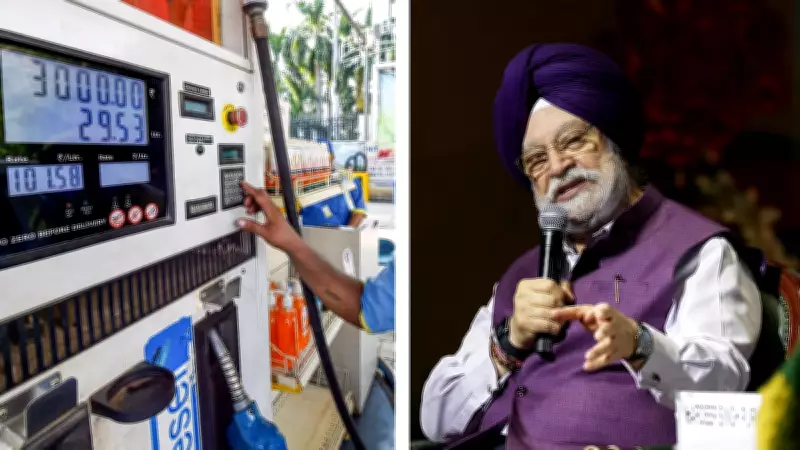
Indian oil companies incurred a staggering loss of Rs 74,781 crore on fuel sales as a result of the ongoing West Asia crisis, Union Minister for Petroleum and Natural Gas Hardeep Singh Puri announced on Thursday. The minister attributed the losses to the surge in international crude oil prices triggered by geopolitical tensions in the region.
Crude Price Volatility and Its Impact
Speaking to reporters, Puri explained that although global crude oil prices have recently declined, domestic oil marketing companies are still processing crude oil that was purchased at elevated prices during the height of the crisis. This lag between purchase and processing has led to significant under-recoveries on the sale of petrol, diesel, and other petroleum products.
"International crude oil prices have come down, but companies are still processing crude they bought at the height of the West Asia crisis," Puri said. The minister did not specify the time frame over which these losses accumulated, but industry experts estimate that the period of peak prices lasted several months.

Breakdown of Losses and Market Dynamics
The Rs 74,781-crore figure represents the total under-recovery across all fuel segments, including petrol, diesel, and liquefied petroleum gas (LPG). State-owned oil marketing companies—Indian Oil Corporation (IOC), Bharat Petroleum Corporation Limited (BPCL), and Hindustan Petroleum Corporation Limited (HPCL)—bore the brunt of these losses, as they were forced to sell fuels at government-capped retail prices despite soaring input costs.
According to data from the Petroleum Planning and Analysis Cell (PPAC), the average price of India's crude oil basket jumped to over $100 per barrel during the crisis, compared to around $75 per barrel earlier. This spike eroded the profit margins of oil companies, leading to the substantial loss reported by Puri.
Government Measures and Future Outlook
Puri assured that the government is monitoring the situation closely and has taken steps to mitigate the impact on consumers and companies. He highlighted that the Centre has reduced excise duty on petrol and diesel twice in the past year to cushion the blow for end-users. However, state-level value-added tax (VAT) remains high in several states, limiting the overall reduction in retail prices.
"The government is committed to ensuring energy security and affordability. We are in constant dialogue with oil companies to manage the transition to lower-cost crude," Puri added. He also noted that the recent softening of international crude prices—now around $85 per barrel—should gradually help companies recover losses as they process cheaper crude in the coming months.
Industry Reactions and Expert Analysis
Industry analysts point out that the losses could have been even higher if not for the government's decision to allow oil companies to revise prices periodically. However, the cap on retail prices has limited their ability to pass on the full cost to consumers. "The under-recoveries are a direct result of the government's price control mechanism," said an analyst from a leading rating agency, who spoke on condition of anonymity. "While this protects consumers from volatility, it exposes oil companies to significant financial risks."
Shares of oil marketing companies have remained under pressure since the crisis began. IOC, BPCL, and HPCL have all reported lower profits in recent quarters, and the cumulative loss figure underscores the severity of the situation. The government may need to consider compensation mechanisms or further price deregulation to ensure the financial health of these critical public sector units.