

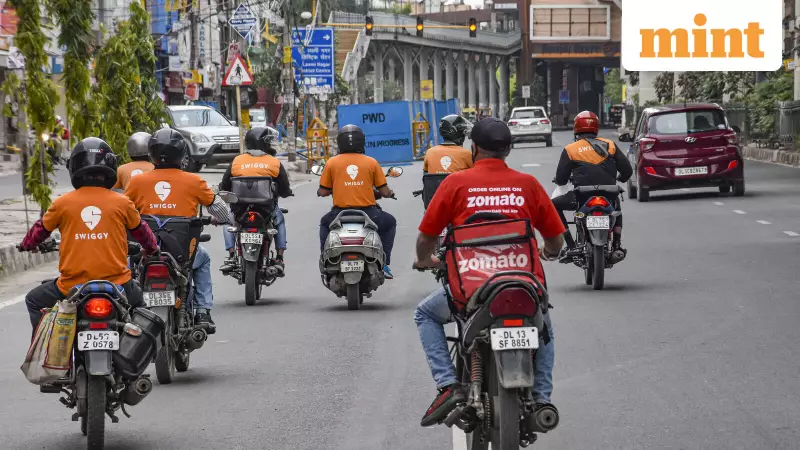
India's food delivery giants Swiggy and Eternal (formerly Zomato) are facing significant financial implications from the newly implemented labour codes, with analysts predicting the changes will add billions to their annual operating costs despite company assurances of minimal business impact.
What The New Labour Code Mandates
Under the Code on Social Security, 2020, which came into immediate effect on Friday, November 24, 2025, platform-based companies must contribute 1-2% of their annual turnover toward a dedicated welfare fund for gig workers. This contribution is capped at 5% of the total payouts made to delivery partners and other platform workers.
The new framework represents a landmark shift, bringing gig and platform workers under a formal social security net for the first time in India. This enables access to accident cover, life insurance, disability benefits, maternity support, health schemes, and old-age protection for millions of delivery partners.

Financial Impact Analysis
While both Swiggy and Eternal have told stock exchanges that the new rules would not have any "material impact" on their business, financial analysts present a contrasting picture. Brokerage firm JM Financial estimates the levy will raise per-order costs by ₹2-3 for both food delivery and quick commerce services.
When applied across projected FY26 order volumes, this translates into staggering additional expenses: approximately ₹4.3 billion for Eternal and ₹2.6 billion for Swiggy at the consolidated level. These costs come at a critical time when both platforms are racing toward profitability with little room to absorb fresh financial shocks.
Karan Taurani of Elara Securities highlighted that at a 5% levy on payouts, rider costs would increase meaningfully. Eternal's delivery costs would rise from 9.8% to 10.3% of gross merchandise value (GMV), while Swiggy's would climb from approximately 11.6% to 12.2%.
Customer Impact Inevitable
Analysts unanimously agree that given the current financial position of both companies, the additional burden is almost certain to be passed directly to consumers. "This is a meaningful amount given that these aggregators are far from their own sustainable profitability guidance... companies would eventually pass on the additional burden to their end customers rather than absorb the impact," JM Financial stated in a research note.
This potential price hike represents the fourth significant cost increase mechanism introduced in the past 18 months, joining existing charges such as platform fees of ₹13-15, small-order charges, peak-hour and surge pricing, and GST adjustments for hyperlocal delivery. While customers have gradually adjusted to previous increases, analysts note that lower-value orders remain particularly sensitive to price changes.
Current Financial Health of Delivery Platforms
The additional costs come despite both companies already spending approximately 1% of their revenue on gig-worker insurance, which includes accidental coverage of ₹10 lakh and medical coverage of ₹3-4 lakh. A 2% mandate under the new code would effectively double this existing expenditure.
Recent financial results underscore the challenges: Swiggy posted an Ebitda margin of (-)19% in recent filings, with its net loss widening to ₹1,092 crore in Q2FY26 despite revenue growth of 54.4% year-on-year to ₹5,561 crore. Eternal's situation shows similar pressures, with net profit falling 63% to ₹65 crore even as revenue surged 183% year-on-year to ₹13,590 crore.
Some cushion exists in the form of rising average order values. Swiggy's net adjusted order value stands at approximately ₹385 in food delivery and ₹488 in quick commerce, while Eternal's food delivery NAOV is similar at ₹385 and Blinkit's around ₹520. Within this context, a ₹2-3 levy represents only a small fraction of total order value.
Implementation Challenges Ahead
Beyond the immediate financial impact, industry experts anticipate structural challenges in implementing the new code. The frequent movement of delivery partners between different platforms complicates contribution tracking, while multi-business models blur the connection between turnover and gig-worker payouts.

The shift toward first-party inventory-led models, which inflate revenue figures, could potentially widen the levy base. Additionally, the fundamentally different economics of food delivery versus quick commerce make applying a uniform framework particularly challenging.
The government has indicated that benefit delivery may be routed through existing mechanisms such as AB-PMJAY (Ayushman Bharat - Pradhan Mantri Jan Arogya Yojana) and state welfare boards. In the most recent fiscal period, Eternal processed insurance worth ₹700 million for gig workers, while Swiggy covered approximately ₹180 million.
As of Q2FY26, Eternal had roughly 555,000 delivery partners on Zomato and 339,000 on Blinkit, while Swiggy and Instamart together engaged about 691,000 delivery partners, highlighting the massive scale of workers affected by these new regulations.





