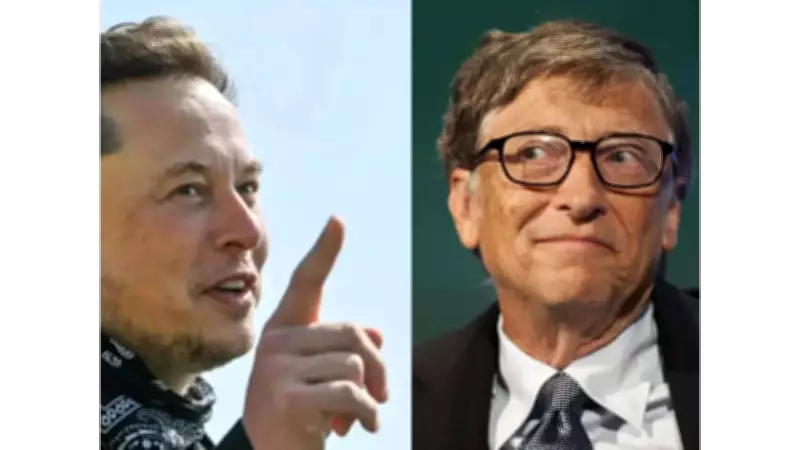
The Enduring Rivalry: Musk and Gates Clash Over Ethics and Tesla Bets
The global technology landscape is dominated by visionary leaders, but few rivalries capture public attention like the ongoing friction between Elon Musk and Bill Gates. These two titans of industry, while celebrated for their innovations, have a well-documented history of disagreements. Their latest public exchange has reignited discussions about business ethics, investment strategies, and personal conduct.
A Social Media Spark Ignites Old Flames
The controversy resurfaced on social media platform X when a user referenced a New York Times report detailing Bill Gates apologizing to Gates Foundation staff over connections to Jeffrey Epstein and admitting to affairs. The post linked this to Tesla short sellers, suggesting they often lack a strong moral compass. Elon Musk, never one to shy away from commentary, responded succinctly with: "Karma is real."
This brief reply was a clear allusion to the deep-seated issue at the heart of their feud: Gates' financial bet against Tesla. The Microsoft co-founder reportedly took a substantial short position against the electric vehicle company, a move that has fueled Musk's public criticism for years.

The $500 Million Bet That Started It All
The core of the Musk-Gates rivalry stems from Bill Gates' decision to short sell Tesla stock, a position valued at approximately $500 million. In conversations with Musk biographer Walter Isaacson, Gates revealed this investment led to a direct and tense exchange with the Tesla CEO. Musk confronted Gates via text, bluntly asking if he had indeed taken the short position. Gates confirmed but attempted to pivot the conversation toward potential philanthropic collaborations.
Musk's response was unequivocal and sharp. "Sorry, I cannot take your philanthropy on climate change seriously when you have a massive short position against Tesla, the company doing the most to solve climate change," he replied. This highlighted the perceived hypocrisy in Gates advocating for environmental causes while betting against a leading clean energy firm.
Understanding the Mechanics of Short Selling
For those unfamiliar with financial markets, short selling is a sophisticated trading strategy where investors profit from a decline in a company's stock price. The process involves:
- Borrowing shares of a stock from a broker.
- Selling these borrowed shares at the current market price.
- Hoping to repurchase the shares later at a lower price to return them to the lender.
- Profiting from the difference if the price falls, but incurring losses if it rises.
This high-risk approach has placed Gates in a precarious position. According to Isaacson's biography, Gates' Tesla short was underwater by a staggering $1.5 billion when the stock traded around $400 per share. With Tesla shares currently hovering near $417, the financial pressure remains significant.
Musk's Warnings and Predictions of Financial Ruin
Elon Musk has not hesitated to publicly challenge Gates on this financial gamble. In late 2024, Musk amplified the feud by sharing a post stating, "If Tesla does become the world's most valuable company by far, that short position will bankrupt even Bill Gates."
Following shareholder approval of his monumental $1 trillion compensation package last year, Musk issued a stark warning during a victory lap. He advised, "If Gates hasn't fully closed out the crazy short position he has held against Tesla for ~8 years, he had better do so soon." These comments underscore Musk's confidence in Tesla's trajectory and his belief that Gates' bet is fundamentally flawed.
The Musk-Gates dynamic transcends mere business competition; it embodies a clash of philosophies, ethics, and visions for the future. As both men continue to shape technology and global markets, their public disagreements serve as a compelling narrative of power, principle, and personal rivalry in the modern era.