

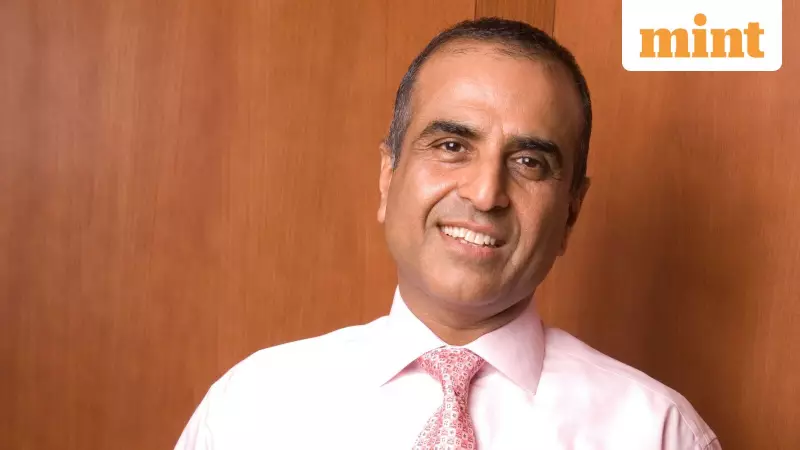
Sunil Mittal, the founder and chairman of Bharti Enterprises, has declared that India is currently experiencing a "Goldilocks moment"—a period uniquely favourable for economic advancement. Speaking at the HT Leadership Summit in New Delhi on Friday, he urged the nation to seize this critical window to finalise long-pending trade agreements, massively accelerate infrastructure investment, and build domestic capabilities in artificial intelligence (AI) and digital technologies.
Seizing the Golden Opportunity for Viksit Bharat
Mittal described the current environment as one where growth is positive, India's work ethic is excellent, and global partners view the country "on equal terms." He linked this optimism directly to national leadership and the vision of Viksit Bharat (Developed India). "We have a leader who wants India to be the Viksit Bharat. He wants us to be successful. What more can we ask for?" Mittal stated.
He called on policymakers to act swiftly, warning that delays could slow India's growth trajectory. "India must close all its trade deals, then open the opportunities for our country, and invest absolutely heavily into infrastructure. Ease of doing business is very important," he emphasised, highlighting that unfinished negotiations and bottlenecks pose significant risks.

Building Sovereign AI and Digital Backbone
Mittal stressed that the next wave of global innovation will be defined by AI-driven networks that constantly interpret the physical world. To prepare, he argued that India cannot depend entirely on foreign technology giants, known as hyperscalers.
"You have to build a massive amount of AI compute capacity in the country, you have to build AI data centres. You have to have your own cloud," Mittal asserted. He specifically warned that sensitive sectors like banking, defence, and government services cannot rely solely on foreign clouds from Google, Microsoft, or Amazon. "You will need to have a sovereign cloud," he insisted.
As part of this push, he revealed that Airtel is scaling its digital infrastructure, with 250 MW of operational data-centre capacity already live. The company is expanding further, including a new 300 MW facility in Andhra Pradesh being developed with an international partner.
Airtel's AI Democratisation and Global Ambitions
Illustrating this strategy, Mittal pointed to Airtel's recent partnership with Perplexity Pro. This deal offers free access for 12 months to the advanced AI search tool for all of Airtel's roughly 360 million customers across mobile, WiFi, and DTH services. The service, normally priced at around ₹17,000 per year, provides conversational answers, document analysis, and image generation.
Mittal also highlighted the strategic importance of low-earth-orbit (LEO) satellite constellations, noting Bharti-backed OneWeb was an early player before SpaceX's Starlink scaled rapidly. "These become like cell towers in space," he said, adding that telecom companies risk missing a critical area if they fail to adapt.
Reflecting on past challenges, Mittal recalled Airtel's survival through intense industry battles, including the disruptive entry of Reliance Jio in 2016. He credited the company's resilience to its motivated people. This resilience extended to Africa, where Airtel, after a difficult first decade, has emerged as a $15-billion entity and a leading player on the continent.
Looking ahead, Mittal set an ambitious target: to transform Airtel into the world's first telecom company with one billion users, up from about 600 million today. This goal is backed by strong financials. As of September 2025, Bharti Airtel's India wireless customer base grew to 364 million. Quarterly revenue surged 25.7% year-on-year to ₹52,145 crore, while net profit jumped 89% to ₹6,792 crore.

The company also leads on the key metric of average revenue per user (ARPU), which stood at ₹256 per month, compared to Reliance Jio's ₹211.4. Mittal's vision is clear: for a company rooted in India to become the foremost global telecom and digital connectivity multinational within the next 8-10 years.





