Uday Kotak Issues Stark Warning on 'Return of Global Colonialism' by 2026
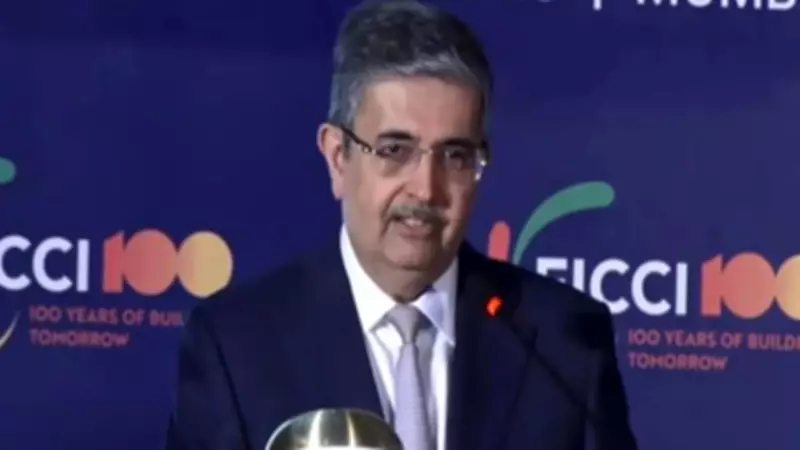
Prominent banker Uday Kotak delivered a sobering address at the FICCI foundation day event in Mumbai, cautioning that the world stands "at a very important cusp of the return of global colonialism." He specifically pointed to 2026 as a pivotal year, drawing direct parallels between historical imperial expansion and the current geopolitical landscape. Kotak emphasized that this critical juncture demands a fundamental reset from Indian industry in its approach to innovation, manufacturing, and national energy security.
Geopolitical Shifts Echo Historical Colonial Patterns
Kotak substantiated his warning by referencing a recent speech by former US President Donald Trump. "He made two points. One, he said whoever wins the war keeps the spoils, and two, if the US gets control of the Straits of Hormuz, it will charge a rent," Kotak recounted. "You are getting back to a world of true colonialism." He argued that these statements reveal a shift towards a world order increasingly dictated by raw power rather than established international rules and norms.
The banker outlined a new global balance of power, dominated by a few nations with significant leverage. "At this stage there are at least three powers with significant leverage over others… one is the US, the second is China, and the third rising because of geopolitics may be even Russia," he stated. This concentration of influence, he suggested, mirrors the dynamics that preceded historical colonial eras.

Drawing Parallels with the British East India Company
To illustrate his point, Kotak drew a detailed comparison with the rise of British colonial rule in India. He explained that the East India Company began as a pure trading entity but leveraged superior technology—specifically guns and gunpowder—to gain overwhelming advantage. "This technology gave them leverage," he said, noting how trade dominance seamlessly transitioned into territorial control. "Through that you saw a trading company become the British Empire in India." Kotak cautioned that similar patterns of technological and economic leverage could be re-emerging today in modern forms, potentially leading to new structures of global dominance.
Reassessing Global Safe Havens and Investment Assumptions
Kotak also raised alarms about changing assumptions regarding global stability, particularly in regions traditionally viewed as safe havens. "We have assumed that many cities in the Middle East are safe… are we beginning to re-examine our assumption?" he questioned. He highlighted that investors who relocated capital and operations for "safer, sounder and tax efficient" environments may now need to urgently reassess those strategic decisions in light of escalating geopolitical tensions.
Urgent Call for Indian Economic and Strategic Reset
Central to Kotak's message was a forceful call to action for India Inc. and policymakers. He criticized the over-reliance on importing technology, asking pointedly, "We believe we can buy technology… but where is the Atmanirbhar Bharat truly?" He urged the country's IT sector, renowned for its services, to aggressively pivot towards product innovation. "Hardly any of them move to 'productise' themselves," he noted, underscoring a significant gap in value creation.
Kotak stressed the imperative of prioritizing national interest, especially in critical sectors like energy security. "How are we going to put country first?" he challenged the audience. He highlighted alarming economic indicators, including a massive $116 billion trade deficit with China, and identified a crucial weakness in India's mid-sized manufacturing ecosystem, specifically for firms with turnovers between Rs 100 crore and Rs 1,000 crore.
Framing this moment as a decisive turning point, Kotak declared, "We have to capture this opportunity with a sense of paranoia and purpose." He warned businesses against complacency, distinguishing between mere cyclical economic recovery and profound structural disruption. "Even if it is a low probability event, it is a high impact event… whatever low probability you put to scenario two, do not put it to zero," he advised, referring to the potential for a complete structural break from the post-1945 world order.

Kotak's comprehensive analysis serves as a clarion call for India to bolster its strategic autonomy, foster indigenous innovation, and build resilient economic structures to navigate the turbulent and potentially neo-colonial global landscape he foresees emerging by 2026.