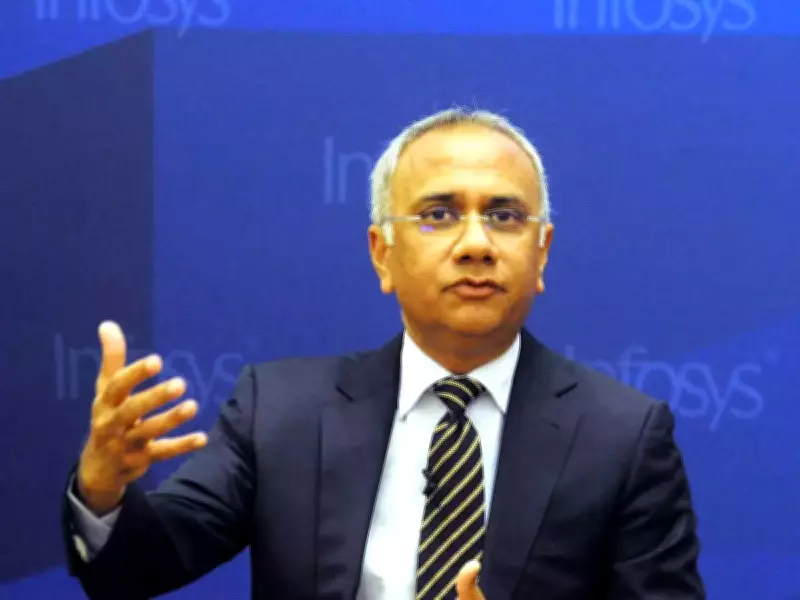
Infosys CEO Salil Parekh Challenges Market Fears Over AI Impact on IT Services
Infosys CEO Salil Parekh has suggested that stock market investors may be misreading the potential impact of advanced AI tools from companies like Anthropic. Contrary to concerns that such technologies could shrink opportunities for IT services firms, Parekh argues they are likely to expand and significantly reshape the demand for their specialized capabilities.
AI Automation Represents Only a Slice of Enterprise Technology Needs
Parekh emphasized that while AI tools can automate certain aspects of software development, this represents only a small fraction of the broader enterprise technology lifecycle. He pointed out that integrating new software into complex legacy systems, rigorous testing, ensuring robust security, deploying into production environments, and maintaining operations at scale present entirely different and substantial challenges.
Most large enterprises operate in what Parekh described as "brownfield" environments—systems built and modified over decades. Introducing sophisticated AI into these intricate landscapes requires orchestrating and integrating multiple technological elements. It also demands a deep understanding of specific industry nuances and individual company contexts—capabilities that IT services firms like Infosys have cultivated over years of extensive digital transformation work.

Market Reaction and a Massive Financial Opportunity
The share prices of leading IT services companies have declined by approximately 15-20% since early this month, coinciding with Anthropic's announcement of a series of new and enhanced AI tools. Parekh views this market reaction as potentially shortsighted.
He projects that AI represents a colossal $300 to $400 billion opportunity for the global IT services industry by the year 2030. This opportunity spans multiple critical areas:
- Assisting enterprises in formulating comprehensive AI strategies.
- Preparing and structuring organizational data for effective AI training.
- Transforming business processes through AI integration.
- Modernizing legacy technology systems to be AI-compatible.
- Ensuring AI systems are trustworthy, ethical, and secure.
Parekh confirmed that clients are actively seeking Infosys' expertise across all these domains, indicating strong existing demand.
Workforce Expansion and the Shift in Required Skills
Parekh envisions the world entering an era where the total volume of required software will explode due to AI proliferation. This growth, he asserts, will ensure that the IT services workforce continues to expand, not contract.
Even as some investors worry that tools from Anthropic and companies like Cognition might reduce the need for large engineering teams, Infosys is continuing to hire at a significant scale. The company is on track to add approximately 20,000 college graduates to its workforce this year and plans to hire a similar number in the following year.
Net headcount at Infosys has increased over the first three quarters of the fiscal year as new projects and work streams are secured. Parekh clarified that the fundamental shift is not toward fewer jobs, but toward jobs requiring different and often more advanced skill sets.
He posited a scenario where even if AI tools multiply engineering productivity many times over, the overall demand for software and integration services could still rise at an even faster rate, ultimately requiring more engineers, not fewer.
Betting on Reskilling and Upholding Fundamentals
Infosys is heavily investing in reskilling its existing employees, a strategy it successfully employed during previous technological shifts like cloud computing and digital transformation. Thousands of Infosys employees are already undergoing certification processes for various AI tools, platforms, and new delivery methodologies.
Parekh also firmly pushed back against the notion that AI makes learning core computing and programming fundamentals optional. He revealed that new freshers at Infosys are still rigorously trained to program without the aid of AI tools initially. Only after mastering these fundamentals are they introduced to AI copilots and agents.

"If you cannot write code yourself, you cannot assess whether the machine's output is correct," Parekh stated, underscoring the enduring importance of foundational skills.
The Future of Talent and Rising Client Expectations
Parekh believes the most valuable talent in the coming AI era will be those who can blend strong engineering prowess with deep domain-specific understanding. While AI agents can automate routine tasks, they often struggle with the subtle nuances and complex contexts unique to specific industries.
He acknowledged, however, that AI tools will inevitably raise client expectations. Enterprises will now demand faster project delivery, tighter system integration, and more clearly measurable business impact from their technology investments, setting a new benchmark for IT service providers.