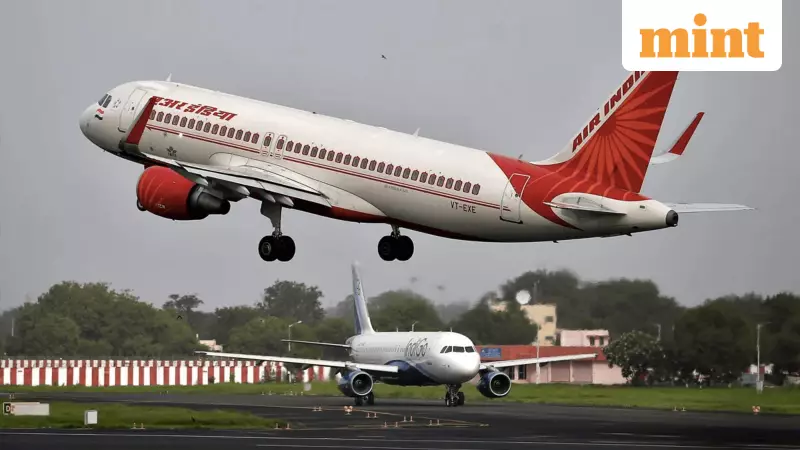
Customer Neglect Proves Costly for India's Aviation Leaders
A stark financial reality has emerged in India's aviation sector, with Air India projecting a staggering $1.6 billion loss and IndiGo reporting a dramatic 78% plunge in profits. These numbers validate what management research has documented for decades: what benefits customers ultimately benefits business. When airlines harm their passengers, they inevitably damage themselves.
IndiGo's Operational Crisis and Ranking Decline
India's two major carriers appear to have forgotten this fundamental principle. IndiGo's December 2025 crisis, which resulted in widespread flight cancellations and stranded hundreds of thousands of passengers, stemmed directly from the company's failure to hire sufficient pilots for new roster rules that had been established well in advance.
The consequences of this operational breakdown are reflected in global rankings. Skytrax's 2025 World Airline Awards, widely regarded as the industry's most authoritative benchmark, placed IndiGo at a disappointing 39th position globally, evaluating factors including in-flight products, cabin service, and ground operations. Meanwhile, AirHelp's 2024 customer satisfaction survey positioned IndiGo at 103rd out of 109 airlines worldwide. While the airline questioned the methodology, there's no denying that the carrier which once revolutionized Indian aviation through operational discipline now exemplifies the dangerous disconnect between rapid expansion and service quality maintenance.

From Operational Excellence to Expansion Obsession
This represents a significant departure from the IndiGo that founders Rakesh Gangwal and Rahul Bhatia established in 2006. Their original vision centered on relentless operational excellence, focusing on affordable fares, punctual departures, and hassle-free service during an era when competitors like Jet Airways and Kingfisher Airlines prioritized luxury offerings. By 2012, IndiGo had become India's largest carrier through a formula that made air travel accessible without compromising basic service standards, earning substantial customer loyalty through consistent performance.
The transformation occurred when rampant expansion began overshadowing customer focus. Last December's operational meltdown exposed an airline that prioritized fleet orders over building adequate operational capacity, revealing systemic weaknesses in their growth strategy.
Air India's Historical Legacy and Current Challenges
Air India's downward trajectory carries particular historical irony. During the 1950s and 1960s under Tata ownership, chairman JRD Tata personally walked cabin aisles to ensure passenger satisfaction, addressed crew about cold meals, and even cleaned dirty counters himself. His meticulous attention to detail established Air India as the gold standard for Asian hospitality. Remarkably, when BOAC introduced faster jet service, passengers still preferred Air India's slower propeller planes due to their superior onboard experience.
Political intervention in 1978 removed JRD Tata from leadership, initiating decades of bureaucratic interference, declining standards, and institutional decay that transformed the nationalized airline into what many described as a flying mess. When the Tata Group repurchased Air India in 2022, passengers anticipated significant improvements. However, in the euphoria of reacquiring their historic asset, the new owners underestimated the depth of normalized customer dissatisfaction they had inherited and implemented insufficient changes to address these systemic issues.
Global Rankings and Customer Feedback
Three years after the ownership transition, Skytrax ranked Air India 84th globally in 2025—a far cry from its historical prominence. Consumer reviews consistently highlight problems including baggage mishandling, staff rudeness, malfunctioning business class seats, and various other service failures that undermine passenger confidence.

Research Validates the Customer-Profit Connection
Studies by Harvard Business Review and Bain & Company demonstrate that increasing customer retention rates by just 5% can boost profits by 25% to 95%. The world's most successful airlines consistently prove that service quality and profitability are complementary rather than contradictory objectives.
Southwest Airlines, which consistently achieves the highest customer satisfaction ratings among low-cost carriers, has simultaneously been the most profitable U.S. airline for decades. Singapore Airlines, which holds a 25% stake in Air India, operates with some of aviation's lowest unit costs while winning Conde Nast's Readers' Choice Award 27 out of 28 times. Their successful formula involves strategic investment in customer experience areas like cabin quality and staff training, while rigorously managing invisible operational costs.
The Service-Profit Chain Framework
India's aviation giants are now paying the price for shifting their focus away from customers. Both airlines have treated passengers as mere inputs in growth strategies rather than recognizing them as the fundamental reason growth matters in the first place.
Harvard Business School's service-profit chain framework, validated across industries since 1994, establishes a clear causal link between employee satisfaction, customer loyalty, and ultimate profitability. When airlines ignore employee capacity while aggressively ordering new aircraft, they break this chain at its foundation. December's crisis at IndiGo and Air India's projected losses represent direct consequences of this strategic misalignment—what happens when quarterly earnings calls prioritize expansion announcements over operational readiness assessments.
The Path Forward for Indian Aviation
IndiGo and Air India now face a critical strategic choice. They can continue treating customers as expendable during periods of aggressive growth, or they can recognize that sustainable expansion requires investments in people, systems, and operational redundancy that may not appear in quarterly reports but prevent catastrophic failures.
Both carriers will undoubtedly survive given India's large and growing aviation market. However, they will only truly thrive by rediscovering what their founders understood from the beginning: everyday service quality forms the critical foundation for sustainable success. Without this foundation, airlines build impressive structures on sand—impressive until the inevitable tide arrives.