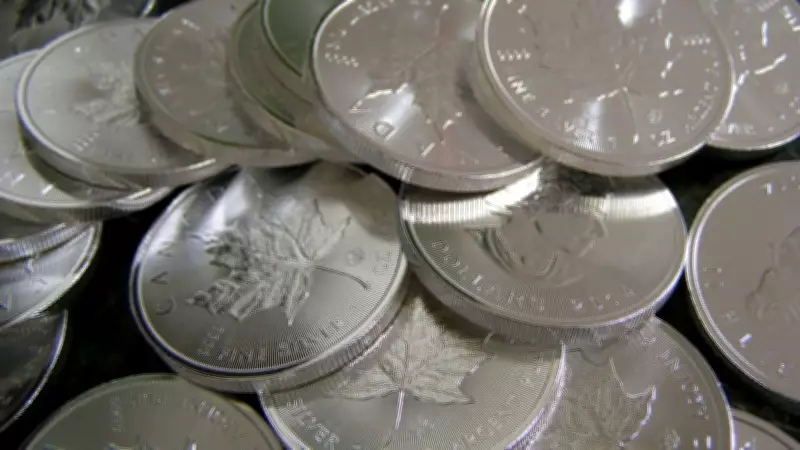
Silver rates continued their downward trajectory on Sunday, February 1, extending losses from the previous trading session. The precious metal declined another 4% as investors rushed to book profits amid a global selloff triggered by a strengthening US dollar. Market sentiment was further dampened by reports that CME Group is raising margins on Comex gold and silver futures contracts. Additionally, investors remained cautious ahead of the upcoming Union Budget 2026, contributing to the bearish pressure.
Domestic Market Performance
On the Multi Commodity Exchange (MCX), silver prices fell significantly, dropping 6% to ₹2,74,410 per kilogram. This decline followed a sharp collapse on Friday, January 30, when silver prices plummeted 19% to ₹3.12 lakh per kg. Just days earlier, on Thursday, silver had touched a record high of ₹4,04,500 per kg before experiencing a dramatic reversal.
Gold prices also faced downward pressure, with MCX gold rates declining 6% to ₹1,40,674 per 10 grams on Sunday. On Friday, gold had plunged 2% to ₹1,65,000 per 10 grams. It is important to note that global commodity markets were closed on Sunday, limiting trading activity to domestic exchanges.

Key Factors Driving the Decline
The fall in precious metals was closely linked to developments in the US currency and derivatives markets. The dollar index rose 0.9% to close at 97.15 after US President Donald Trump nominated Kevin Warsh, a former Federal Reserve governor and known proponent of a strong dollar, to head America's central bank. This development reduced the appeal of safe-haven assets like gold and silver.
Simultaneously, Bloomberg reported that CME Group is increasing margins on Comex gold and silver futures following prices suffering their biggest slides in decades. For gold, margins will rise to 8% of the contract value from the current 6% for non-heightened risk profiles, while heightened risk profile margins will increase to 8.8% from 6.6%.
For silver, margins will climb to 15% from the current 11% for non-heightened risk profiles, with heightened risk profile margins hiking to 16.5% from 12.1%. Margins on platinum and palladium futures will also be boosted, adding to the overall pressure on precious metals.
Global Market Impact
The pressure was even more intense in global markets. On Friday, spot silver slumped $31.44, or 27.07%, to close at $84.70 per ounce after plunging as much as 36% intraday to $73.30 per ounce. Gold also slid by $530.53, or 9.83%, to settle at $4,865.35 per ounce. During the session, gold had tanked $689.92, or 12.8%, hitting an intraday low of $4,683.10 per ounce.
Both metals had earlier touched all-time highs on Thursday, with silver reaching $121.45 per ounce and gold hitting $5,595.02 per ounce, driven by safe-haven demand amid geopolitical tensions.
January Performance Overview
Despite this sudden fall, silver still ended January with sharp gains, rising ₹73,000, or 30.5%, from ₹2,39,000 per kg recorded on December 31, 2025. Gold too delivered a strong monthly rise, with prices increasing by ₹27,800, or 20.2%, from ₹1,37,700 per 10 grams recorded at the end of last year.
The precious metals surge in January was aided by ongoing geopolitical tensions between the US and Iran, and a sharply weaker US dollar amid policy uncertainty in Washington. Escalations of geopolitical tensions—such as U.S.–EU tariff threats tied to Greenland—also triggered a flight to precious metals as investors sought safety.
Technical Outlook and Expert Analysis
Ponmudi R, CEO at Enrich Money, explained that the extreme fall in prices should be viewed in the context of the preceding vertical rally and the structure of the ongoing bull phase rather than as a reversal of the broader trend. He noted that the magnitude of the correction in silver, in particular, reflects how rapidly leveraged positions were unwound after prices had surged to unsustainable highs in a short span of time.
"Silver endured even more extreme volatility, plunging nearly 40% from highs above $118–$121 to around $74–$85 (with lows near $74). This outsized correction aligns with historical late-stage bull phase shakeouts, but silver's hybrid monetary-industrial profile continues to underpin the outlook amid persistent supply tightness and demand growth," he stated.

Support Levels and Future Projections
He highlighted that the $74–$70 zone, which aligns with the 50-day Exponential Moving Average (EMA), now forms a critical demand support area for COMEX silver. Stability above this zone could pave the way for a rebound towards $82, $92 and even $100+ levels as industrial demand tailwinds re-emerge and price momentum rebuilds. The broader ascending channel, he indicated, remains intact and supportive on shallow pullbacks.
In the domestic market, MCX silver has corrected sharply from peaks near ₹4,20,048 per kg to around ₹2,91,925– ₹2,91,000. According to him, while volatility remains elevated, structural support is visible near ₹2,91,000, with stronger alignment around ₹2,51,000– ₹2,52,000 linked to the 50-day EMA. A decisive hold above these levels and a move back above ₹3,00,000– ₹3,10,000 could signal renewed buying interest, potentially accelerating prices towards ₹3,40,000– ₹3,50,000+ amid supply constraints.
"Overall, the sharp correction across gold and silver represents a leverage flush, sentiment reset, and tactical adjustment rather than a trend reversal. Near-term choppiness may linger amid dollar dynamics, but disciplined buying on dips guided by key supports and channel integrity should define the next leg higher in this secular bull market into 2026," Ponmudi R concluded.
Disclaimer: The views and recommendations made above are those of individual analysts or broking companies, and not of Mint. We advise investors to check with certified experts before making any investment decisions.