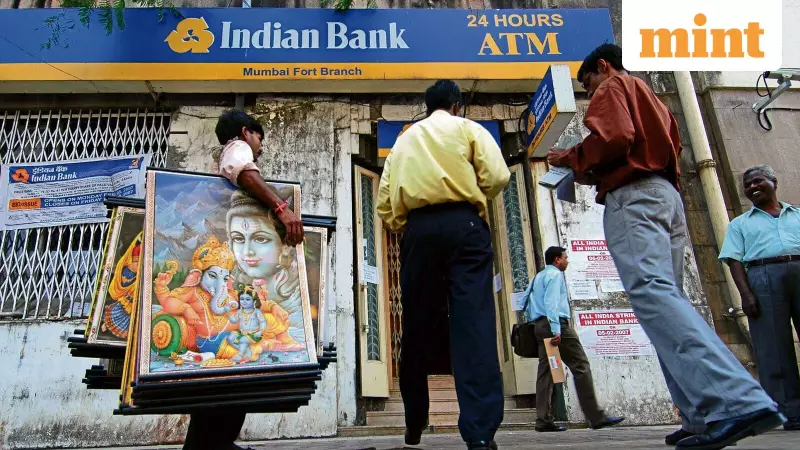
A decade-long investment in Indian Bank would have transformed ₹10,000 into an impressive ₹70,095 today, delivering staggering returns of 601% that dramatically outpaced the broader market. This remarkable performance stands as a testament to the public sector bank's incredible turnaround journey from the depths of the non-performing asset crisis that once crippled India's banking sector.
From Banking Crisis to Remarkable Recovery
The lending boom that characterized India's banking landscape a decade ago later evolved into a significant setback for public sector banks. Loans that slipped into default were not recognized promptly, and a slowing economic environment further intensified the stress. By March 2018, the alarming situation culminated in India's banking system reporting non-performing assets worth ₹10.4 trillion, with public sector banks accounting for a staggering ₹9 trillion of this amount.
The PSU Bank Index crashed dramatically as a consequence, prompting a series of crucial reforms including RBI-led stress recognition, a ₹2.1 trillion recapitalization plan, lending restrictions, and substantial write-offs. These measures gradually began showing positive results, with NPAs at PSBs falling 69% to ₹2.8 trillion by March 2025, while gross NPA ratios improved remarkably from 14.6% to 2.6%.

Indian Bank's Spectacular Transformation
Indian Bank, established in the early 20th century and incorporated on 5 March 1907, emerged as a standout example in this sector-wide transformation. The country's fifth-largest PSU lender not only stabilized its balance sheet but also successfully reshaped its growth trajectory. A significant structural change occurred when the Government of India announced the amalgamation of 155-year-old Allahabad Bank into Indian Bank in 2019, with the combined entity commencing operations on 1 April 2020.
As of 31 March 2025, the bank maintains an extensive physical presence with 5,901 domestic branches spread across rural areas (1,992), semi-urban regions (1,555), urban markets (1,182), and metropolitan cities (1,172). The institution also operates three international branches in Singapore, Colombo, and Jaffna, along with an IFSC Banking Unit in GIFT City, Gujarat.
The bank's core operations focus on deposit mobilization and credit expansion, with total business growing 12.3% year-on-year to ₹13.97 trillion as of 30 September 2025. Digital transformation has played a crucial role in its revival, with digital transactions now constituting 94% of total transactions, significantly reducing dependence on physical branches.
Multibagger Returns That Outpaced Sensex
Indian Bank's stock performance has been consistently strong over the long term. The share price climbed from ₹126.3 a decade ago to ₹885.13 on 19 November 2025, translating a ₹10,000 investment into ₹70,095 – a spectacular gain of 601% despite challenges including the NPA crisis and pandemic disruptions.
This performance significantly outstripped the BSE Sensex, which returned approximately 230% over the same period, rising from 25,842 to 85,187. Since its 2007 listing, Indian Bank shares have delivered extraordinary returns exceeding 771.6%.
The bank's impressive financial metrics tell a compelling story of recovery. Total business expanded almost 50% in just four years, rising from ₹9.2 trillion in FY21 to ₹13.3 trillion in FY25. Net interest margin improved from 2.8% in FY21 to 3.4% in FY25, lifting net interest income by nearly 50% to ₹92.2 billion over the same period.
Most notably, net profit skyrocketed from ₹30 billion in FY21 to ₹109.2 billion in FY25 – a 3.6-fold increase that reflects the institution's dramatically improved operational efficiency and asset quality.
The Road Ahead for Indian Bank
Looking forward, Indian Bank aims to bring its gross NPA below 2% by FY26, improving upon its earlier target of sub-3%. Total recoveries are projected between ₹55 billion and ₹65 billion for the year. The bank continues to focus on managing its cost-to-income ratio, currently at 46.1% as reported in H1FY26.

The institution maintains official credit growth guidance of 10% to 12%, expected to be driven primarily by consumption sectors, particularly automobile loans and consumer goods. Strategic emphasis remains on expanding low-cost savings accounts, with targeted approaches for salary accounts that offer stability and cross-selling opportunities.
Digital innovation continues to be a priority, with Indian Bank introducing Agentic AI-based wise calling for collections, expected to help reduce the Special Mention Account book. The bank has empanelled 168 fintech companies for customized solutions to enhance business growth.
The broader banking industry delivered better-than-expected profit performance in Q2 FY26, with PSU banks gaining market share and currently growing credit at 14%. JM Financial anticipates bank credit growth accelerating to 13% by end-FY26, supported by stronger demand for automobiles and discretionary goods following recent tax cuts.
As a fundamental pillar of India's economic growth cycle, the banking sector appears well-positioned to sustain its current momentum, though investors must carefully evaluate fundamentals, governance standards, and valuations before making investment decisions.