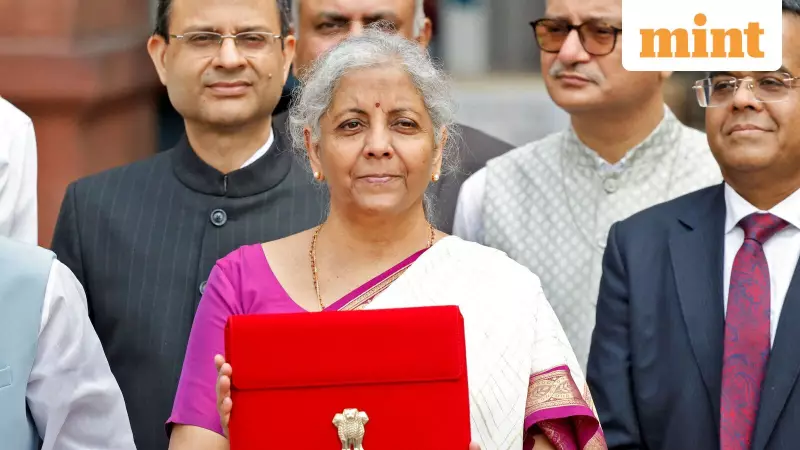
Budget 2026: Nirmala Sitharaman's Ninth Union Budget and Tax Reform Legacy
Finance Minister Nirmala Sitharaman is set to present her ninth consecutive Union Budget on 1 February 2026, marking another milestone in her tenure. Over the past five years, she has fundamentally reshaped India's tax landscape through a series of bold reforms that have impacted millions of taxpayers across the country. From making the new tax regime the default option to overhauling capital gains rules and introducing cryptocurrency taxation, her budgets have consistently aimed at simplification and modernization of India's tax system.
Key Tax Reforms Under Sitharaman's Leadership
For the salaried class, Budget Day remains one of the most anticipated events of the fiscal calendar, with expectations primarily centered around potential changes to income tax structures. During her tenure, Sitharaman has introduced numerous tax reforms that have provided significant relief to various income groups while streamlining the overall taxation process.
Significant Relief for Middle-Class Taxpayers
One of the most notable achievements has been the progressive increase in effective tax-free thresholds for salaried individuals. In her Budget 2025 speech, Sitharaman raised the effective tax-free threshold to ₹12.75 lakh, which included a standard deduction of ₹75,000. This move provided substantial relief to middle-class taxpayers across India.

Earlier, Budget 2023 had already unveiled a simplified tax regime that exempted taxpayers earning up to ₹7 lakh annually. With the standard deduction of ₹50,000 at that time, salaried individuals with incomes up to ₹7.5 lakh paid no tax under the new tax regime, marking a significant step toward reducing the tax burden on lower-income brackets.
Comprehensive Capital Gains Reforms
Budget 2024 introduced sweeping changes to both short-term and long-term capital gains taxation that fundamentally altered how investment returns are taxed in India. The short-term capital gains (STCG) rate on certain financial assets was increased from 15% to 20%, while long-term capital gains (LTCG) underwent even more substantial restructuring.
Before Budget 2024, LTCG on equities exceeding ₹1 lakh were taxed at 10%, while gains from properties and select non-equity assets faced a 20% tax with indexation benefit. This indexation benefit had been particularly valuable as it significantly reduced tax liability by adjusting gains against inflation-adjusted costs.
Budget 2024 made LTCG uniform at 12.5% across all asset classes, removed the indexation benefit, and raised the exemption limit to ₹1.25 lakh. The budget also redefined holding periods for various capital assets, establishing only two thresholds: 12 months or one year for listed assets such as shares and listed bonds, and 24 months or two years for other assets including real estate and gold.
Evolution of the New Tax Regime
The new tax regime, first introduced as an optional alternative in Budget 2020, offered concessional tax rates but removed the benefits of certain deductions and exemptions available under the old regime. This represented a fundamental shift in India's tax philosophy, moving toward simplification and lower rates in exchange for fewer deductions.
In a significant move toward tax simplification, Budget 2023 made the new tax regime the default option, requiring all taxpayers to file under it unless they explicitly opted for the old regime. This decision was aimed at making the tax filing process more straightforward for the average taxpayer while encouraging broader adoption of the simplified system.
Standard Deduction Enhancements
Budget 2024 brought further enhancements to the standard deduction framework. The Finance Minister raised the standard deduction for salaried employees under the new tax regime to ₹75,000, while also increasing the family pension deduction from ₹15,000 to ₹25,000 for those following the new tax regime.

The same budget introduced a new tax slab structure for those following the new tax regime: no tax up to ₹3 lakh; 5% tax between ₹3-7 lakh; and 10% tax between ₹7-10 lakh. This progressive structure aimed to provide relief to lower and middle-income taxpayers while maintaining revenue collection.
Taxation of Digital Assets
In response to the growing prominence of digital currencies and assets, Budget 2022 imposed a 30% tax on virtual digital assets along with an additional 1% TDS on transfers of these assets. This marked India's first formal recognition and taxation framework for cryptocurrency and other digital assets, bringing them into the formal tax net.
Assessment Reopening Time Limits
To provide greater certainty to taxpayers and reduce prolonged litigation, Budget 2021 reduced the time limit for reopening assessments from six years to three years. However, in serious tax evasion cases involving concealment of income of ₹50 lakh or more in a year, assessments could still be reopened for up to 10 years, maintaining a balance between taxpayer convenience and enforcement needs.
As Finance Minister Nirmala Sitharaman prepares to present Budget 2026, taxpayers across India will be watching closely to see how these reforms evolve and what new measures might be introduced to further simplify India's tax system while supporting economic growth and taxpayer welfare.