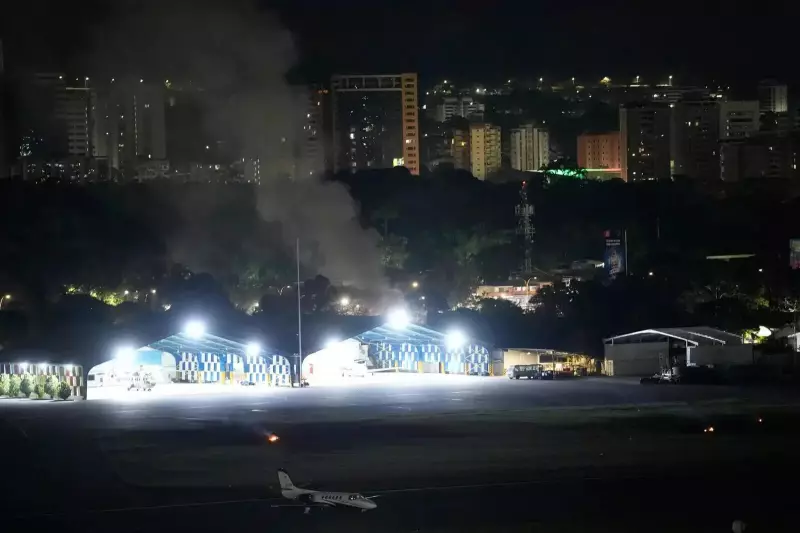
The government of Venezuela has launched a fierce accusation against the United States, alleging it carried out military attacks on civilian and military sites within its territory. This dramatic escalation followed reports of at least seven explosions and low-flying aircraft over the capital, Caracas, in the early hours of Saturday, around 2 am local time.
Nationwide Emergency and Call to Arms
In a swift and decisive response to the incident, President Nicolás Maduro declared a nationwide state of emergency. He ordered the immediate implementation of all national defence plans and issued a rallying cry for a 'mass mobilisation' of supporters. The Venezuelan government, in an official statement, explicitly blamed the United States for the aggression and urged its citizens to take to the streets.
"People to the streets!" the statement proclaimed, calling on all social and political forces in the country to activate mobilisation plans and condemn what it termed an "imperialist attack." The government framed the declaration as a "state of external disturbance," directly pointing the finger at Washington.

US Confirms Strikes, Cites Drug War Justification
Confirming the military action, US officials later informed CBS News that President Donald Trump ordered strikes on sites inside Venezuela, including military facilities. This move marks a significant intensification of Washington's longstanding campaign against the Maduro administration.
The Trump administration justified the strikes as a necessary escalation in its war on drugs, claiming the targeted operations were aimed at stemming the flow of narcotics into the United States. US forces have been active in the region for months, with a notable military buildup that included the deployment of the advanced USS Gerald R Ford aircraft carrier and other warships to the Caribbean Sea.
In recent weeks, the US has seized two oil tankers off Venezuela's coast and launched deadly strikes on more than 30 boats allegedly carrying drugs. Official figures released by the Trump administration state that, as of Friday, these maritime operations have resulted in at least 115 people killed.
Venezuela's Fierce Diplomatic Rejection and Broader Tensions
Venezuela's formal response was scathing. The government's statement, shared on social media platform X by Colombian President Gustavo Petro, rejected and denounced the "extremely serious military aggression." It specified that the attacks targeted areas in Caracas, and the states of Miranda, Aragua, and La Guaira.
The statement accused the United States of a flagrant violation of the United Nations Charter, arguing it breached principles of sovereignty and the prohibition on the use of force. "The objective of this attack is none other than to seize Venezuela's strategic resources, particularly its oil and minerals, attempting to break the Nation's political independence by force," it declared, adding defiantly, "They will not succeed…"
This incident occurs amid already sky-high tensions. In a recent interview, Maduro alleged that the US seeks to force a government change in Venezuela to gain control of its vast oil reserves, a campaign he claims began with the major US military deployment to the Caribbean in August. Furthermore, Maduro himself faces narco-terrorism charges in the United States.
The situation represents one of the most direct confrontations between the two nations in years, threatening regional stability in Latin America and the Caribbean and marking a dangerous new chapter in their protracted conflict.