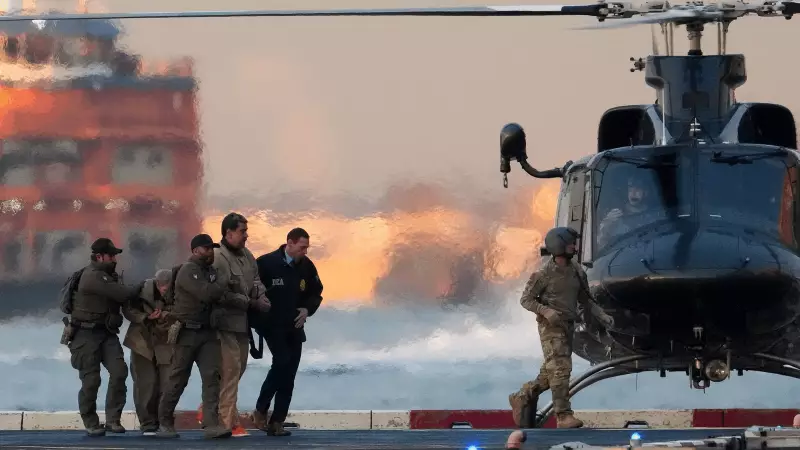
Recent military actions by the United States in Venezuela have sparked global debate, with many questioning Washington's true objectives. While initial rhetoric suggested a push for regime change, a closer examination reveals a more complex picture focused on strategic energy interests, leaving the core political structure of the South American nation intact.
The Illusion of Regime Change
Despite the dramatic operation aimed at ousting leader Nicolás Maduro, no fundamental political shift has occurred in Caracas. The United Socialist Party of Venezuela (PSUV) remains firmly in control. Key figures of the Maduro government, including interim President Delcy Rodríguez, her brother Jorge Rodríguez who heads the National Assembly, Defence Minister General Vladimir Padrino López, and Interior Minister Diosdado Cabello, all retain their positions.
This continuity suggests Washington's goals were more limited. Analysts believe the US may have accepted a mediated proposal for "Madurismo without Maduro," allowing a transitional government led by figures like Delcy Rodríguez to maintain stability without a complete overhaul of the ruling apparatus.

Oil: The Central Strategic Prize
If regime change was not the primary goal, then what drove the operation? The answer lies beneath Venezuela's soil. The nation possesses the world's largest proven oil reserves, estimated at 303 billion barrels, surpassing even Saudi Arabia. For decades, the US was the primary destination for Venezuelan crude, receiving over 50% of exports during Hugo Chávez's rule and 35-50% under Maduro until 2025.
Former US President Donald Trump explicitly linked the operation to oil, stating US companies would invest billions to repair infrastructure and "start making money for the country." However, this is a long-term prospect. Restoring production to significant levels could require up to $100 billion in investment, a challenging feat given Venezuela's political instability and damaged oil infrastructure.
Global Repercussions and India's Stance
The US action, conducted in conjunction with the Pentagon and CIA, has been widely condemned as a violation of international law by numerous world leaders and US senators. This sets a dangerous precedent that other global powers might exploit in their own regions.
For India, the situation requires careful navigation. New Delhi has issued a prudent statement expressing "deep concern" and prioritizing the welfare of the Venezuelan people. While not a close political ally of the Chavista government, India is a significant economic partner. Indian firms like Reliance Industries, Nayara Energy, ONGC Videsh, Indian Oil, and Oil India have stakes in Venezuelan oilfields. A dominant return of US oil majors could squeeze out these Indian importers and investors, impacting India's energy security.
The road ahead for Venezuela remains fraught with challenges of poverty, hyperinflation, and broken institutions. The hope for Venezuelans is that external intervention does not plunge the nation into further chaos. While immediate democracy seems distant, the best outcome may be a path to legitimate elections and a leader who can begin to heal the nation's deep wounds.