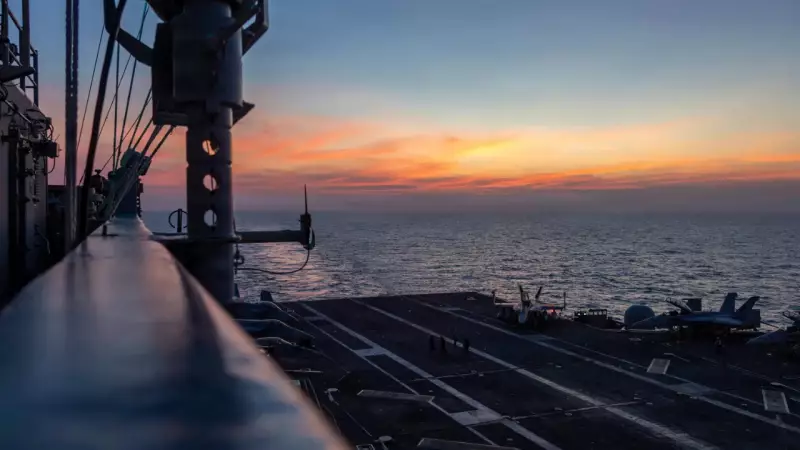
The United States has significantly bolstered its military presence in the Middle East by deploying the aircraft carrier USS Abraham Lincoln along with three accompanying warships to the region. This strategic move has reignited concerns about the possibility of President Donald Trump ordering military action against Iran, which is currently grappling with widespread protests and a violent government crackdown.
Carrier Strike Group Position and Regional Impact
The US Central Command confirmed on Monday that the carrier strike group is currently operating in the Indian Ocean rather than the Arabian Sea, which directly borders Iran. This deployment marks a substantial increase in American military capability in a region that has been without a US aircraft carrier since October last year, when the USS Gerald R Ford was redirected to the Caribbean as part of Washington's pressure campaign against then-Venezuelan President Nicolás Maduro.
According to the Associated Press, this deployment brings thousands of additional American service members to the Middle East. In a social media statement, Central Command emphasized that the USS Abraham Lincoln and its three destroyers were deployed specifically "to promote regional security and stability." Defense officials have noted that this carrier group dramatically enhances both offensive and defensive capabilities for US forces operating in the area.

Trump's Statements and Iran's Internal Crisis
President Trump acknowledged the military buildup last week, telling reporters the ships were sent "just in case" while suggesting that military action remains a viable option. "We have a massive fleet heading in that direction, and maybe we won't have to use it," he stated, maintaining ambiguity about potential escalation.
This deployment coincides with weeks of escalating unrest in Iran, where protests that began in late December have been met with severe government repression. Human rights activists estimate that at least 5,973 people have been killed and more than 41,800 individuals detained during the crackdown. Earlier, Trump had explicitly warned of military action if Iran carried out mass executions of prisoners or killed peaceful demonstrators.
Shifting Rhetoric and Continued Threats
More recently, however, Trump appeared to moderate his stance by claiming that Tehran had halted planned hangings of 800 detained protesters. Iran's top prosecutor promptly dismissed this claim as "completely false," highlighting the ongoing diplomatic tensions between the two nations.
Despite this apparent shift in tone, Trump has continued to keep the threat of military force active. Speaking to reporters aboard Air Force One on Thursday, he warned that any US military response would make last year's strikes on Iranian nuclear sites "look like peanuts" if the Iranian government proceeded with planned executions of protesters.
Enhanced Military Capabilities in the Region
Alongside the carrier deployment, the US military has substantially increased its air presence throughout the Middle East. Officials have confirmed that F-15E Strike Eagle fighter jets are now operating from bases in the region, while analysts tracking flight data have observed dozens of US military cargo planes heading toward the area.
The USS Abraham Lincoln carries advanced F-35C and F/A-18 fighter jets, along with EA-18G Growler aircraft specifically designed to jam enemy air defenses. The three accompanying Navy destroyers possess the capability to launch Tomahawk cruise missiles, significantly expanding the strike options available to US forces.
Defensive Preparations and Historical Context
In addition to these offensive capabilities, the United States is moving Patriot and THAAD air defense systems into the region to protect American forces and allied nations from potential Iranian retaliation, according to defense officials cited by the Washington Post.
The current military activity closely mirrors preparations observed last year, when the US reinforced regional defenses ahead of an anticipated Iranian response following strikes on its nuclear facilities. That previous escalation culminated in Iran launching multiple missiles at the Al Udeid Air Base in Qatar, demonstrating the volatile nature of US-Iran tensions in the region.