Former US President Donald Trump has once again amplified his longstanding ambition to acquire Greenland, framing the purchase of the self-governed Danish territory as an "absolute necessity" for American survival. While his initial 2019 proposition was widely dismissed as an eccentric real estate fantasy, Trump has persistently highlighted the island's strategic value for the United States, consistently downplaying interest in its mineral wealth in favour of national security arguments.
The Geopolitical Chessboard: Greenland's Pivotal Location
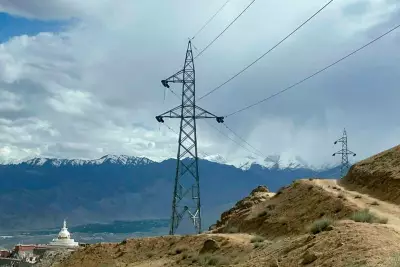
Greenland's immense geographical significance is the cornerstone of Trump's argument. Positioned off Canada’s northeast coast and extending deep into the Arctic Circle, it lies astride the shortest air and sea routes between North America and Europe. This location has been deemed strategically vital since World War II, when the US acted to block Nazi expansion. For a worldview that prioritises military positioning and control of choke points, Greenland represents a crucial extension of US strategic depth.
The melting Arctic ice, a consequence of climate change, is unlocking new shipping lanes and access to resources, transforming the region into a zone of intense competition. Trump's narrative that rivals capitalise on such openings while America hesitates finds a potent example here. A more navigable Arctic elevates Greenland's value as a platform for monitoring Russian military activity and securing North Atlantic routes that are gaining economic importance.

Beyond Minerals: The Military and Alliance Calculus
Despite Trump's public focus on security over minerals, Greenland's substantial deposits of rare earth elements—critical for smartphones, defence technology, and green energy—undergird the economic logic. Controlling these resources could, in theory, help reduce US reliance on China in crucial supply chains, aligning with Trump's "economic nationalism." However, extraction is hampered by harsh conditions and environmental regulations, barriers Trump typically labels as bureaucratic red tape.
The US already maintains a significant military foothold via the Pituffik Space Base (formerly Thule Air Base) in northwestern Greenland, operated under a 1951 defence pact with Denmark. This base is central to US missile warning, defence, and space surveillance systems. Furthermore, Greenland's proximity to the GIUK Gap (Greenland–Iceland–UK)—a key naval corridor for tracking Russian submarines—makes it indispensable for NATO's North Atlantic deterrence posture.
Leverage in a Multipolar Arctic: Russia, China, and NATO
Trump's Greenland push is inextricably linked to great power competition. Russia has significantly bolstered its Arctic military presence, while China declares itself a "near-Arctic state" and promotes a "Polar Silk Road." US strategists across administrations fear the Arctic becoming a contested space like the South China Sea. For Trump, this translates into a blunt imperative: block Chinese strategic and economic inroads near US territory.
The Greenland question also becomes a lever in Trump's transactional approach to alliances. As part of the Kingdom of Denmark, any expanded US role involves negotiations with Copenhagen, a NATO ally. Trump has consistently argued that the US bears a disproportionate security burden. Denmark's own Arctic investments, including new vessels and an Arctic command, can be framed as "not enough," reinforcing Trump's demand for greater US access or advantages in return for its protective umbrella, especially after Russia's invasion of Ukraine sharpened European security anxieties.
Greenland's government, however, remains unequivocal in its stance, repeatedly asserting that "Greenland is not for sale." This sets the stage for a complex geopolitical tug-of-war, where cold strategic calculations meet the firm will of a self-governing territory.