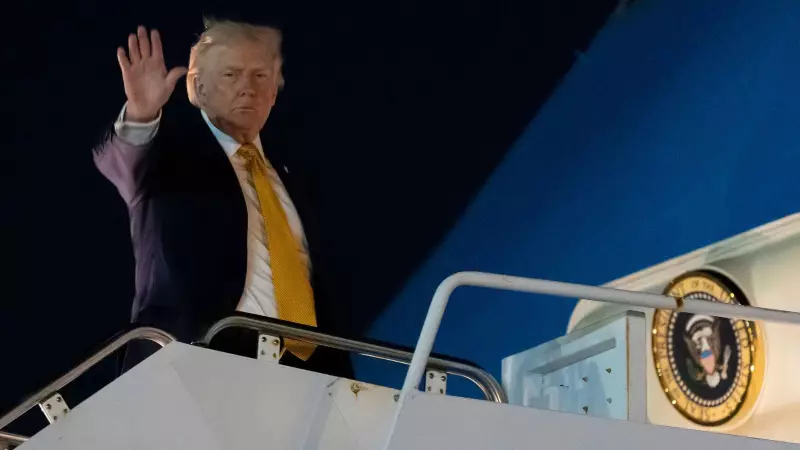
Former US President Donald Trump has issued a stark warning to India, stating he could impose significant tariffs on the country if he wins the November presidential election. The threat is directly linked to India's continued purchases of Russian crude oil, a practice Trump claims undermines Western efforts to isolate Moscow financially.
The Core of Trump's Warning
In a recent interview, Trump explicitly connected potential trade actions against India to its energy imports from Russia. He argued that while the United States and its allies are attempting to enforce a price cap on Russian oil, nations like India are not adhering to this mechanism. "India is not respecting the price cap," Trump stated, framing the issue as one of fairness and strategic alignment.
This warning comes amidst Trump's broader campaign rhetoric, where he has frequently advocated for aggressive use of tariffs as a primary tool of foreign policy. His comments suggest that a second Trump administration would take a much harder line on countries perceived as not cooperating with US-led economic sanctions, with India now squarely in the crosshairs over its energy policy.

India's Strategic Energy Calculations
India, the world's third-largest oil importer, has dramatically increased its intake of Russian crude since the onset of the Ukraine conflict in 2022. The driving force behind this shift is purely economic: discounted Russian oil offers substantial savings for the Indian economy. This pragmatic approach has allowed India to manage inflation and reduce its import bill, even as it maintains diplomatic ties with Western nations.
New Delhi has consistently defended its position, stating that as a developing nation with massive energy needs, it must source oil from the most cost-effective suppliers. Indian officials have also pointed out that European nations continue to import refined petroleum products made from Russian crude, complicating the moral argument. The Indian government has not officially responded to Trump's latest comments, but the threat adds a new layer of complexity to its delicate balancing act between Washington and Moscow.
Potential Ramifications for Bilateral Relations
The imposition of tariffs by the US would represent a major disruption to the steadily growing trade relationship between the two democracies. Bilateral trade between India and the US surpassed $191 billion in the 2022-23 period, making America India's largest trading partner. Targeted tariffs could hit a range of Indian exports, from machinery and pharmaceuticals to textiles and agricultural products.
Analysts warn that such a move would not only strain economic ties but could also spill over into the strategic and defense partnership, which has been a cornerstone of US policy in the Indo-Pacific region aimed at countering China. The threat introduces significant uncertainty for Indian businesses and policymakers, who must now consider the real possibility of a protectionist US trade policy returning in 2025.
Trump's warning underscores a fundamental divergence in priorities. For the US, enforcing the G7-led price cap on Russian oil is a geopolitical tool to curtail Moscow's war funding. For India, securing affordable energy is a non-negotiable economic imperative. How this clash is resolved could define the trajectory of US-India relations for years to come, testing the resilience of their much-celebrated strategic convergence.