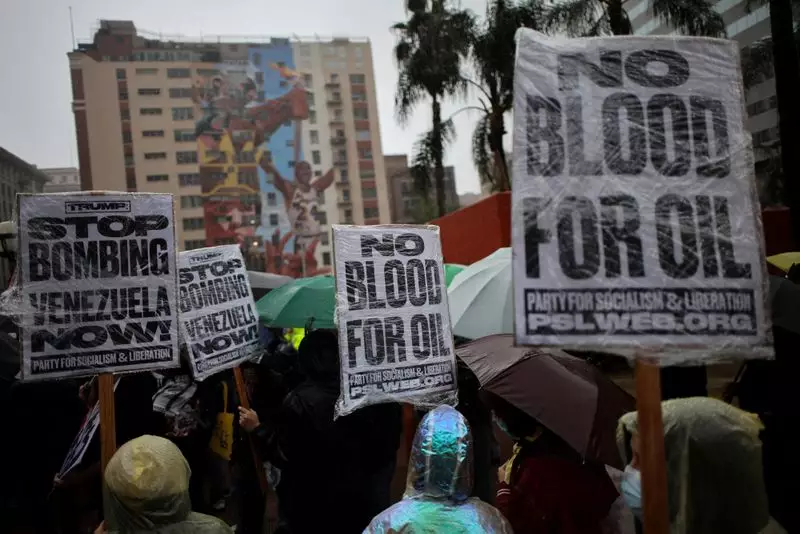
In a statement that has sent shockwaves through international diplomatic circles, former US President Donald Trump has declared that the United States has developed a strategy to temporarily administer Venezuela and harness its massive petroleum resources. This revelation adds a new, contentious layer to the long-standing political and economic crisis gripping the South American nation.
The Core of Trump's Assertion
Speaking at a recent event, Trump outlined a plan he claimed was formulated during his presidency. The central objective is for the US to "run" Venezuela on an interim basis, with a primary focus on gaining control over what are considered the world's largest proven oil reserves. This move, according to Trump, is intended to stabilize the country's crippled economy and infrastructure, which have suffered under years of hyperinflation and political turmoil under President Nicolas Maduro.
Trump emphasized that this would not be a permanent arrangement but a necessary step to restore order. He argued that accessing Venezuela's oil wealth could also serve American interests by boosting global energy supplies and potentially lowering fuel prices, a persistent concern for US consumers. The former president did not provide a specific timeline for this proposed intervention but framed it as a pragmatic solution to a protracted crisis.

Geopolitical Context and Immediate Reactions
This proposition comes against a backdrop of intense geopolitical rivalry. Venezuela has been a key ally of Russia and China, both of which have provided significant economic and political support to the Maduro regime. A direct US intervention, as suggested by Trump, would likely be viewed as a major provocation by these global powers and could escalate tensions significantly.
Unsurprisingly, the statement drew swift condemnation from the Venezuelan government. Officials in Caracas labeled the remarks as a blatant admission of imperialist ambitions and a violation of international law and Venezuelan sovereignty. They reiterated their support for President Maduro and vowed to resist any foreign intervention.
Reactions within the United States have been sharply divided along partisan lines. Critics of the former president have denounced the idea as reckless and a dangerous escalation that could lead to military conflict. They warn that such a plan would alienate allies in Latin America and beyond, painting the US as an aggressor nation. Supporters, however, have echoed Trump's view that strong action is needed to address the humanitarian disaster in Venezuela and to counter the influence of adversarial states in America's hemisphere.
Implications for Global Energy Markets and Diplomacy
The potential implications of such a strategy are vast. Successfully tapping Venezuela's oil reserves, estimated at over 300 billion barrels, could alter global energy dynamics. It could increase supply, influence OPEC+ decisions, and provide the US with greater leverage in energy geopolitics. However, the path to achieving this is fraught with immense challenges:
- Military and Logistical Hurdles: Any effort to physically control oil fields and infrastructure would require a substantial and risky commitment of resources.
- International Legitimacy: The plan would face fierce opposition in the United Nations and from numerous countries, making it difficult to assemble a coalition of support.
- Domestic Venezuelan Resistance: Despite the country's problems, nationalist sentiment remains strong, and any foreign administration would likely face persistent opposition and instability.
Furthermore, this announcement complicates ongoing diplomatic efforts. It could harden the position of the Maduro government in any future negotiations and empower hardliners who argue that the US's ultimate goal is regime change and resource extraction.

In conclusion, Donald Trump's claim about a US plan to run Venezuela and exploit its oil has ignited a fresh debate on interventionism and energy security. While it reflects a certain hawkish strand of American foreign policy thinking, its feasibility and wisdom are hotly contested. The idea underscores the deep entanglement of Venezuela's political fate with its natural resource wealth and the enduring struggle for influence in the Western Hemisphere. As the 2024 US presidential election approaches, such foreign policy pronounceations are set to remain a focal point of discussion, with significant consequences for US-Venezuela relations and global stability.