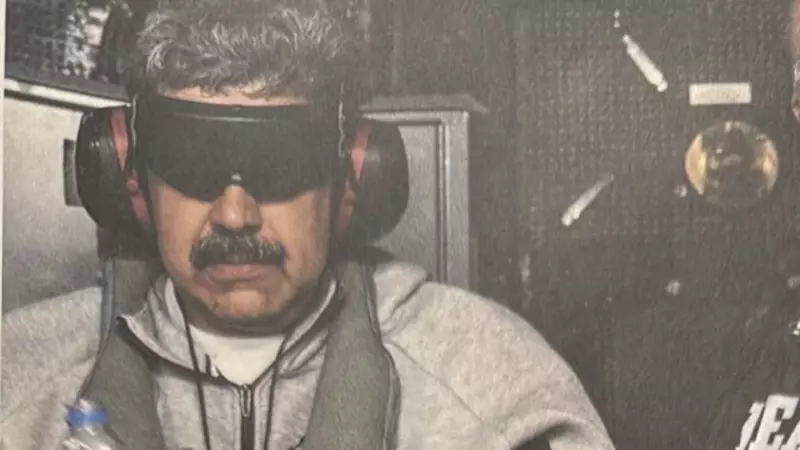
In a move that has escalated a very public and personal feud, former United States President Donald Trump has released the first known photograph of Venezuelan President Nicolas Maduro on board a US warship. The image, shared on Trump's Truth Social platform, shows Maduro standing on the deck of the USS Iwo Jima, an amphibious assault vessel.
The Provocative Post and Its Immediate Backstory
The release of this photograph did not happen in a vacuum. It comes directly on the heels of a fiery exchange between the two leaders. Just a day earlier, Nicolas Maduro had delivered a lengthy and impassioned speech during his campaign rally. In that address, he launched a scathing attack on Trump, labeling him a "bandit," "thief," and "moral misery." Maduro accused the former US president of attempting to orchestrate his assassination and of plundering Venezuela's economic resources.
Donald Trump's response was swift and visually striking. Instead of a lengthy rebuttal, he posted the photograph on his social media channel. The image is stark: President Maduro is seen in a dark suit, standing alone on the expansive flight deck of the massive warship. Accompanying the photo was a concise but loaded caption from Trump: "Nicolas Maduro on the USS Iwo Jima." The post was made on a Saturday, instantly capturing global attention.

Unpacking the Symbolism of the USS Iwo Jima
The choice of the USS Iwo Jima as the setting is deeply symbolic and adds layers of meaning to Trump's message. The USS Iwo Jima (LHD-7) is a Wasp-class amphibious assault ship, essentially a small aircraft carrier capable of deploying Marines, helicopters, and attack aircraft. It is a premier instrument of US military power projection.
This vessel was actively involved in US military exercises and deployments in the Caribbean Sea, a region Venezuela considers its strategic backyard. For years, the US has used naval deployments as a tool of pressure against Maduro's government. By showcasing the Venezuelan leader on the deck of this specific ship, Trump's post serves multiple purposes: it is a reminder of overwhelming US military might, a visual assertion of US influence in the region, and a direct counter to Maduro's accusations of weakness and criminality.
Historical Context and the Trump-Maduro Dynamic
The relationship between Donald Trump and Nicolas Maduro has been one of intense hostility. During his presidency from 2017 to 2021, Trump's administration implemented a policy of "maximum pressure" against Venezuela. This involved crippling economic sanctions, diplomatic isolation, and open support for opposition leader Juan Guaido, whom the US recognized as the country's legitimate interim president.
The Trump administration consistently portrayed Maduro as a dictator and a narco-trafficker. Notably, in 2020, the US Justice Department indicted Maduro and several of his top aides on charges of narco-terrorism, offering a $15 million reward for information leading to his capture. The posting of the warship photo fits into this established pattern of confrontation and psychological pressure.
Interestingly, the current US President, Joe Biden, has maintained many of the sanctions but has also engaged in limited diplomatic outreach, including a prisoner swap deal. Trump's action is seen by analysts as both a critique of Biden's approach and a reassertion of his own hawkish stance.
Potential Repercussions and Regional Impact
The release of this photograph is likely to have several immediate consequences. Firstly, it significantly personalizes the geopolitical conflict between the US and Venezuela, framing it as a clash between two strongman leaders. This could harden positions on both sides and make diplomatic overtures more difficult.
Secondly, within Venezuela, Maduro may use Trump's post as propaganda to bolster his nationalist credentials, portraying himself as a leader who stands up to American imperialism, even while being pictured on its warship. For Trump, the move reinforces his image among his base as a leader who is unafraid to confront US adversaries directly and theatrically.

Finally, for other nations in Latin America and the Caribbean, the incident is a stark reminder of the volatile nature of US-Venezuela relations and its potential to destabilize the region. It underscores how the personal dynamics between leaders can influence international affairs.
In conclusion, Donald Trump's decision to publish the first photo of Nicolas Maduro on the USS Iwo Jima is far more than a social media post. It is a calculated political act laden with military symbolism, intended as a powerful retort to Maduro's insults and a statement of aggressive foreign policy. This exchange marks a new, more visually dramatic chapter in the long-running tension between the United States and Venezuela, with implications that extend far beyond the deck of a single warship.