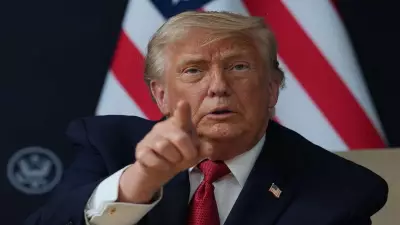
Former United States President Donald Trump has indicated a significant escalation in his stance towards Iran, revealing that he is exploring military options against the Islamic Republic. This move comes as Trump asserts that Tehran's actions, particularly in the context of its internal protests, have crossed a critical threshold.
Trump's Stark Warning and the 'Red Line'
In a statement that has sent ripples through international diplomatic circles, Donald Trump declared that Iran appears to have crossed its 'red line'. The context for this serious allegation is the ongoing and widespread protests within Iran. While the exact nature of the triggering event remains detailed in his broader remarks, the former President's language suggests a point of no return in his assessment of the regime's behaviour.
The core of Trump's accusation hinges on the Iranian government's response to its own citizens. He implied that the suppression and actions taken against protesters have reached a level that the international community, and specifically his administration's perspective, cannot ignore. This framing positions the internal situation in Iran not just as a domestic issue, but as a potential catalyst for international intervention.

Exploring Military Avenues: A Shift in Posture
More concretely, Trump confirmed that he is actively exploring military options in relation to Iran. This represents a notable hardening of position. The exploration of such options typically involves strategic reviews, consultations with defence officials, and an assessment of potential targets and consequences.
This development did not occur in a vacuum. It follows a period of heightened rhetoric and tension between Trump and the Iranian leadership. The former President's policy towards Iran during his term was marked by maximum pressure, including the unilateral withdrawal from the JCPOA nuclear deal and the targeted killing of General Qasem Soleimani. His latest comments signal a potential return to, or intensification of, that confrontational approach.
Implications and Global Repercussions
The implications of a former US president openly discussing military action against a sovereign nation are profound. Firstly, it injects immediate volatility into an already unstable region. Nations across the Middle East, as well as global powers with interests in the Strait of Hormuz, will be closely monitoring any follow-up to these statements.
Secondly, it places the current protests in Iran under an even more intense global spotlight. Protesters within the country may view this as potential external support, while the Iranian regime will likely use it to frame the unrest as being fuelled by foreign adversaries, thereby justifying further crackdowns.
Finally, this stance could influence the broader geopolitical landscape. It may affect ongoing negotiations, however stalled, regarding Iran's nuclear programme. It also sends a clear message about the foreign policy direction Trump advocates, which could have ramifications for global alliances and security calculations far beyond the immediate US-Iran conflict.
The world now watches to see if these explorations of military options translate into concrete plans or remain as strategic posturing. The date of January 12, 2026, marks a significant moment where verbal warnings edged closer to the realm of actionable threats, setting a precarious stage for the future of US-Iran relations.