Texas Conservative Activist Ignites Controversy Over 90-Foot Hanuman Statue
A Texas-based conservative activist has ignited a significant cultural and political controversy after questioning the presence of a monumental 90-foot-tall statue of Lord Hanuman at the Shri Ashtalakshmi Temple in Sugar Land, Texas. The incident has sparked widespread debate about religious freedom, immigration, and cultural assimilation in America.
Activist's Provocative Claims on Social Media
Carlos Turcios, a Republican activist from the Dallas–Fort Worth metropolitan area, shared a video of the impressive statue on the social media platform X. In his post, Turcios made inflammatory remarks, claiming that "third World Aliens are slowly taking over Texas and America" and urging people to "stop the invasion." His comments immediately drew sharp criticism from various quarters, particularly from the Indian-American community.
The Monumental Panchaloha Abhaya Hanuman Statue
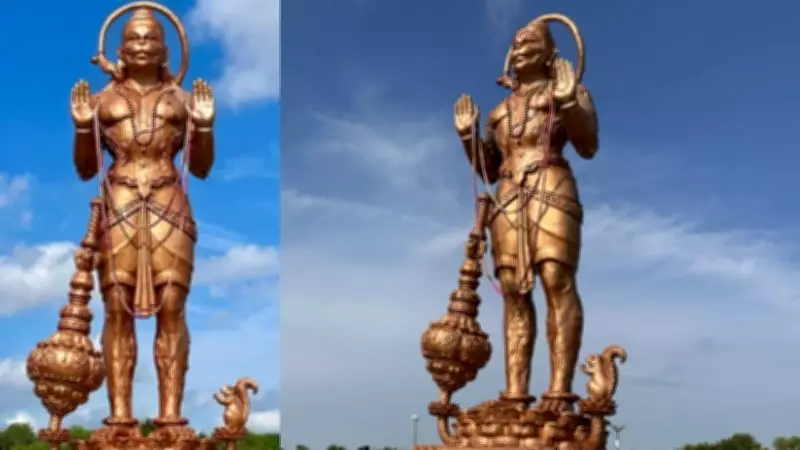
The statue in question is known as the Panchaloha Abhaya Hanuman, a magnificent representation of the Hindu deity revered for strength and devotion. Inaugurated in August 2024, this architectural marvel stands as the tallest statue of its kind in all of North America. Temple officials have described it as more than just a religious icon—it serves as a symbol of strength, unwavering devotion, and a spiritual epicenter dedicated to promoting peace and harmony within the community.

Indian-American Community's Forceful Response
The Indian-American community responded swiftly and forcefully to Turcios' provocative statements. One community member pointed out the fundamental rights involved, writing: "It's on private property—built by Hindus on land they own and with their own money. You lost the culture war years ago, and you're about to lose the midterms too. Your 'America First' grift is exposed as racist nostalgia."
Another commenter presented compelling data about assimilation, comparing language statistics in the United States: "There are 41 million households that speak Spanish in the US. Yet there are no Indian languages in the top 10. Since household language is the strongest indicator of assimilation, you have a long way to go before your group is anywhere near the assimilation level of Indian-Americans." This response highlighted the community's successful integration into American society.
Broader Context of Immigration Criticism
This incident is not Turcios' first foray into criticizing Indian immigration. He has previously targeted H-1B visas, claiming that Indian immigrants were "invading" areas like Frisco, Texas. Turcios finds himself among several prominent political figures who have criticized the H-1B visa system. Former presidential candidate Nikki Haley's son Nalin Haley, former Congresswoman Marjorie Taylor Greene, and Florida Governor Ron DeSantis have all advocated for extended bans on the H-1B visa program, arguing that it is exploitative in nature and disadvantages American workers by allegedly scamming them out of employment opportunities.
Hinduism's Growing Presence in American Politics
Interestingly, the controversy unfolds against a backdrop of increasing Hindu representation in American political circles. Several prominent figures associated with the Trump administration and Republican politics follow Hinduism, including former presidential candidate Vivek Ramaswamy, former Congresswoman Tulsi Gabbard (who served on the House Intelligence Committee), former FBI official Kash Patel, and Usha Vance, wife of Vice President J.D. Vance. This demonstrates the growing diversity within American political leadership and the expanding influence of Hindu Americans in national discourse.

Cultural Significance and Community Resilience
Despite the online controversy stirred by Turcios' comments, the Hanuman statue remains a profoundly significant cultural and religious symbol for the local Indian-American community in Texas. Temple officials continue to welcome visitors from all backgrounds, emphasizing the statue's role as a beacon of peace and spiritual connection. The community's response has highlighted their commitment to religious freedom, cultural preservation, and constructive dialogue in the face of divisive rhetoric.
The incident serves as a microcosm of broader debates about immigration, cultural diversity, and religious expression in contemporary America. As the 2024 election cycle approaches, such controversies are likely to continue shaping political discourse around these fundamental American values.