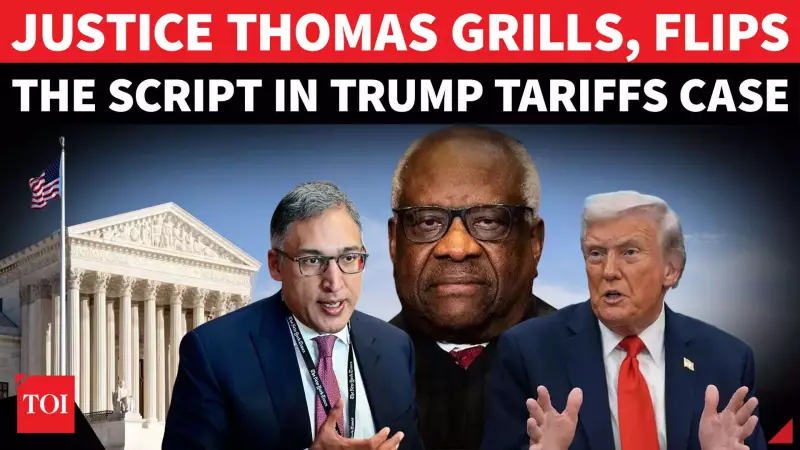
The United States Supreme Court is currently hearing arguments in a landmark case that could fundamentally reshape presidential authority over international trade. At the heart of this legal battle lies a crucial question: did the International Emergency Economic Powers Act (IEEPA) grant former President Donald Trump the legal authority to impose sweeping tariffs without seeking approval from Congress?
The Core Legal Challenge
This high-stakes constitutional debate reached the nation's highest court after three separate lower courts unanimously ruled that President Trump's tariff actions exceeded his legal authority. These previous rulings maintained that such unilateral trade decisions violated the fundamental constitutional principle of separation of powers between the executive and legislative branches of government.
The legal proceedings took an interesting turn when Justice Clarence Thomas engaged in a pointed exchange with a Democratic lawyer during oral arguments. Justice Thomas posed a hypothetical scenario questioning what the response would be if China held a U.S. citizen hostage, probing the limits of presidential power in international economic matters.

Historical Context and Legal Framework
The International Emergency Economic Powers Act (IEEPA) has long been the legal foundation granting presidents emergency powers to regulate international commerce during national crises. However, the current case tests whether this decades-old legislation can be interpreted to allow broad tariff impositions without congressional oversight during non-emergency situations.
Legal experts following the case closely note that the Supreme Court's eventual ruling could establish precedent affecting how future presidents approach trade policy. The decision might either reinforce congressional authority over trade matters or significantly expand executive power in international economic relations.
Potential Implications for Global Trade
The outcome of this case carries substantial implications beyond American borders. International trade partners and global markets are closely monitoring developments, as the ruling could determine how much flexibility future U.S. administrations have in implementing trade policies that affect worldwide commerce.
Legal analysts suggest that a ruling in favor of expanded presidential authority could lead to more volatile trade relationships, while a decision upholding congressional power might create more predictable, but potentially slower-moving, trade policy mechanisms.
The Supreme Court's deliberation comes at a time when global trade relationships remain particularly sensitive, with many nations carefully watching how the United States balances executive authority against legislative oversight in matters of international economic policy.