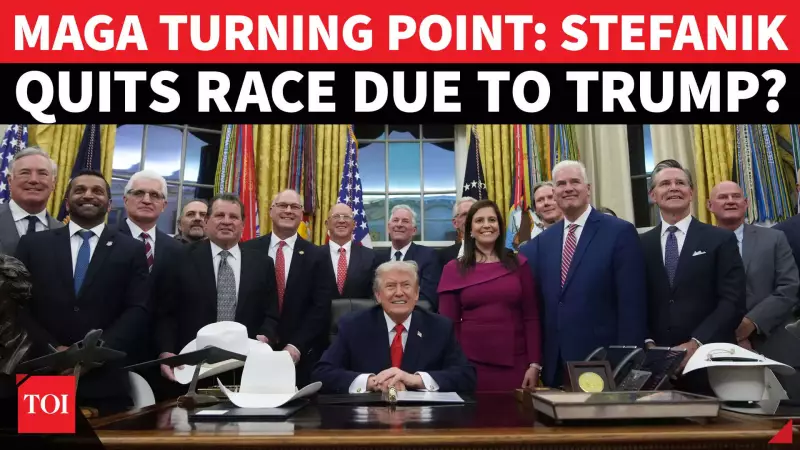
In a stunning political reversal, Republican Congresswoman Elise Stefanik has abruptly ended her campaign for New York Governor and announced she will not seek re-election to the House of Representatives. The decision, announced on December 21, 2025, is attributed to strategic calculations and a critical lack of expected support, most notably from former President Donald Trump.
The Trump Factor: A Triple Blow to Ambitions
According to insiders within the Republican Party, the most significant element forcing Stefanik's exit was Donald Trump's repeated refusal to back her candidacy. Sources reveal that Trump declined to endorse her not once, but on three separate occasions, including a direct conversation in the Oval Office. This lack of support from the party's most influential figure made her path to victory exceedingly difficult.
Stefanik had launched a high-profile bid to challenge and unseat the current Democratic Governor of New York, Kathy Hochul. However, her campaign prospects dimmed considerably when Bruce Blakeman, a known Trump ally, entered the Republican primary. With Trump choosing to remain officially neutral in the contest, Stefanik's forward momentum effectively stalled, narrowing her political options to a dead end.

Strategic Retreat and a Vacated Seat
Elise Stefanik's surprise withdrawal represents more than just a failed gubernatorial run; it marks a sudden retreat from her congressional career. By declaring she will not seek re-election to Congress, Stefanik is vacating a secure Republican seat, creating an unexpected opening in the party's lineup. This dual exit underscores the depth of the strategic reassessment prompted by Trump's stance.
The timing and nature of her announcement have sent shockwaves through Republican circles. It highlights the immense, and often decisive, power that Donald Trump continues to wield over the party's primary elections and the careers of its rising stars. For a figure like Stefanik, who had carefully cultivated a profile as a staunch Trump defender, the absence of his endorsement proved insurmountable.
Broader Implications for the GOP
This development raises urgent questions about the future of Republican leadership in Democratic-leaning states like New York. Stefanik was viewed as a prominent GOP figure capable of mounting a serious challenge in a tough political environment. Her departure from the scene leaves a void in the state's Republican leadership.
Furthermore, the incident puts a spotlight on the intense intra-party dynamics within the GOP. It demonstrates that alignment with Trump's ideology is not always enough; his active personal endorsement remains a critical currency. The episode serves as a case study in how Trump's neutrality can be as powerful as his support, effectively determining the fate of candidacies.
The fallout from Stefanik's decision is likely to influence how other Republican candidates navigate their relationships with the former president. It also prompts a larger discussion about the party's strategy for reclaiming ground in states where Democrats have held a strong advantage. For now, the New York governor's race has been dramatically reshaped, and the future of one of the GOP's most visible figures has been abruptly redirected.