The Ring of Fire: A Comprehensive Guide for UPSC Aspirants
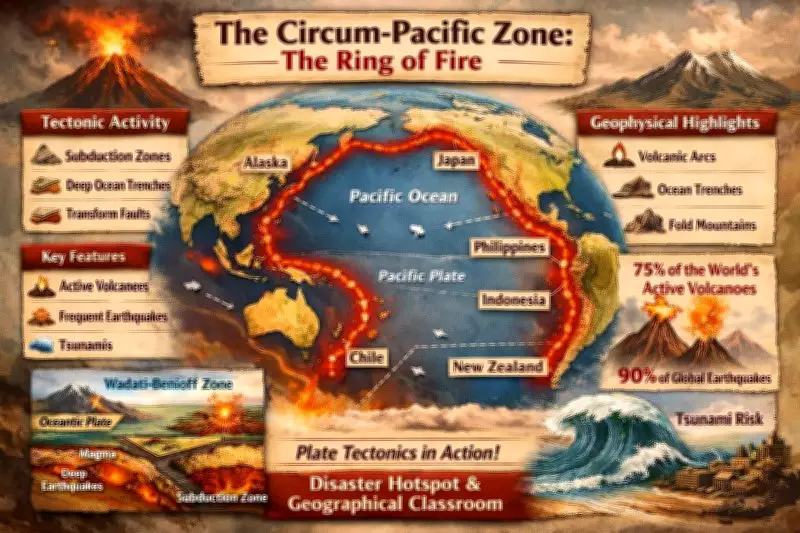
The Circum-Pacific Zone, universally recognized as the Ring of Fire, stands as the planet's most geodynamically active and seismically volatile region. This immense, horseshoe-shaped belt meticulously encircles the vast expanse of the Pacific Ocean, creating a dramatic landscape defined by relentless seismic activity, towering volcanic arcs, profound ocean trenches, and intricate plate boundary interactions. For dedicated civil services aspirants, mastering this topic is absolutely essential, as it directly pertains to the Physical Geography segment of GS Paper 1, the geography optional syllabus, disaster management strategies, and even contemporary international relations discussions concerning natural hazards.
Geophysical Characteristics of the Ring of Fire
The Ring of Fire is distinguished by a suite of remarkable geophysical features that underscore its dynamic nature. This zone is home to approximately 75% of the world's active and dormant volcanoes, including iconic peaks like Mount Fuji in Japan and Mount St. Helens in the United States. Furthermore, it witnesses about 90% of the Earth's earthquakes, ranging from minor tremors to catastrophic mega-thrust events. The region is also characterized by deep oceanic trenches, such as the Mariana Trench, which represents the deepest point on Earth's surface. These trenches are formed by the subduction of tectonic plates, a process that also gives rise to volcanic island arcs like the Aleutian Islands and the Philippines archipelago.
Tectonic Setting and Plate Boundaries
The intense activity within the Ring of Fire is fundamentally driven by the complex interactions of several major tectonic plates. The Pacific Plate, one of the largest on Earth, is converging with surrounding plates including the North American Plate, the Eurasian Plate, the Indo-Australian Plate, and the Nazca Plate. The primary tectonic processes at work here are:

- Subduction Zones: Where oceanic plates dive beneath continental plates, generating deep trenches and fueling volcanic activity through mantle melting.
- Transform Boundaries: Such as the San Andreas Fault in California, where plates slide past each other horizontally, causing significant seismic events.
- Spreading Centers: Although less common, mid-ocean ridges like the East Pacific Rise contribute to the region's tectonic framework.
This convergence and subduction are responsible for the creation of the "Pacific Ring of Fire" and its associated hazards, making it a critical area of study for understanding global tectonics.
Importance for UPSC GS Paper 1 and Beyond
For UPSC candidates, the Ring of Fire is not merely a geographical curiosity but a pivotal topic with multifaceted implications. In GS Paper 1, questions often focus on the distribution of volcanoes and earthquakes, the theory of plate tectonics, and associated landforms. Geography optional students must delve deeper into the seismicity, volcanism, and geomorphological evolution of this zone. Moreover, knowledge of the Ring of Fire is indispensable for disaster management, as it helps in comprehending risk assessment, mitigation strategies, and preparedness for tsunamis and volcanic eruptions. In the realm of international relations, the shared risks across Pacific Rim nations foster cooperation on early warning systems and humanitarian aid, highlighting the topic's contemporary relevance.
In summary, the Circum-Pacific Zone, or Ring of Fire, is a testament to Earth's dynamic processes. Its study equips UPSC aspirants with a robust understanding of physical geography, enhances their analytical skills for disaster-related questions, and provides insights into global geopolitical cooperation on natural hazards, making it an indispensable component of civil services examination preparation.