In an unprecedented military action that has sent shockwaves across the globe, the United States has captured Venezuelan President Nicolás Maduro, forcibly removing him from power. The extraordinary overnight operation, announced by former US President Donald Trump, has abruptly ended Maduro's controversial rule and plunged Venezuela into a new political era. The immediate question now is: who will lead the nation? The answer points squarely towards the country's most prominent opposition leader, María Corina Machado.
The Dawn Raid That Toppled a Regime
In the early hours of Saturday, residents of Caracas were jolted awake by the sound of at least seven explosions. The apparent attack, which lasted less than 30 minutes, saw people rushing into the streets in panic. This was the opening salvo of what US officials described as a "large-scale strike" on Venezuela.
The operation's primary objective was clear: to apprehend President Nicolás Maduro and his wife, Cilia Flores. US forces successfully captured the couple and flew them out of the country. Former President Trump broke the news on his Truth Social platform shortly after 4:30 a.m. ET, stating, "This operation was done in conjunction with U.S. Law Enforcement. Details to follow." He confirmed the strike was carried out successfully and promised a news conference later that day.

The Venezuelan government, led by Vice President Delcy Rodríguez, was thrown into disarray. Rodríguez admitted they did not know the whereabouts of Maduro and Flores and issued a stark demand: "We demand proof of life."
Maduro's Legal Reckoning in the US
The capture was not merely a political move but a legal one. US Attorney General Pam Bondi confirmed that both Maduro and his wife would face criminal charges in the United States, stemming from a 2020 indictment in the Southern District of New York. Bondi declared they would "soon face the full wrath of American justice on American soil in American courts."
The charges are severe. During Trump's first term, the Justice Department accused Maduro of transforming Venezuela into a criminal enterprise that served drug traffickers and terrorist groups. A New York indictment specifically accused Maduro and socialist leader Diosdado Cabello of conspiring to "flood the United States with cocaine" and use the drug trade as a weapon against America. It was previously unknown that Flores had also been indicted.
María Corina Machado: The Opposition Figurehead in the Spotlight
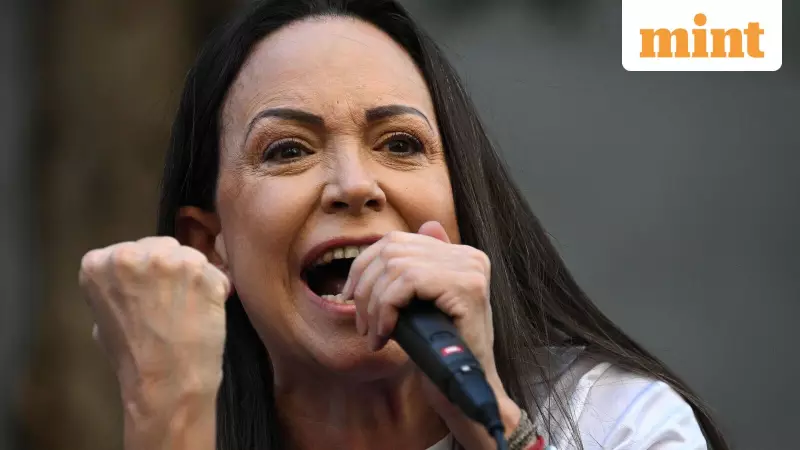
With Maduro removed, the vacuum of power has instantly shifted the world's attention to María Corina Machado. For years, she has been the most prominent and galvanising face of Venezuela's opposition, channelling widespread public anger over economic collapse, mass migration, and political repression.
Her political journey is marked by defiance. An industrial engineer by training, Machado co-founded the election monitoring group Súmate in 2001. She was elected to the National Assembly in 2010, becoming one of the country's highest vote-getters. In 2023, she won the opposition's unity primary in a landslide, positioning herself as the strongest challenger to Maduro. However, the regime barred her from holding public office for 15 years, a move that triggered an election crisis.
Following the disputed July 2024 election, Machado went into hiding for nearly a year, citing threats to her life. She emerged last month to travel to Norway, where she was awarded the 2025 Nobel Peace Prize, adding to her international accolades like the Sakharov Prize. Supporters view her as an uncompromising symbol of resistance, though her periods in hiding have limited her ability to organise openly inside Venezuela.
An Uncertain Path to Leadership
While Machado is the obvious figure to watch, her path to formally leading Venezuela is fraught with uncertainty. Spokespeople for Machado have declined to comment on the US operation. Any stable transition would require the lifting of political bans and sanctions, the organisation of fresh elections, and a framework agreed upon by various factions.

The US administration, however, is signalling a new beginning. US Deputy Secretary of State Christopher Landau called Maduro's seizure "a new dawn for Venezuela," proclaiming, "The tyrant is gone." Secretary of State Marco Rubio reiterated that Maduro's government lacked legitimacy. Senator Mike Lee of Utah revealed that Rubio briefed him, stating that Maduro had been arrested by US personnel and would stand trial in the United States, and that no further action in Venezuela was anticipated now that Maduro was in custody.
The dramatic events of this Saturday have irrevocably altered Venezuela's trajectory. The nation, long suffering under economic sanctions and authoritarian rule, now stands at a precarious crossroads. The world waits to see if María Corina Machado, the engineer-turned-dissident-turned-Nobel laureate, can navigate the immense challenges ahead and lead her country toward the democratic future she has long championed.