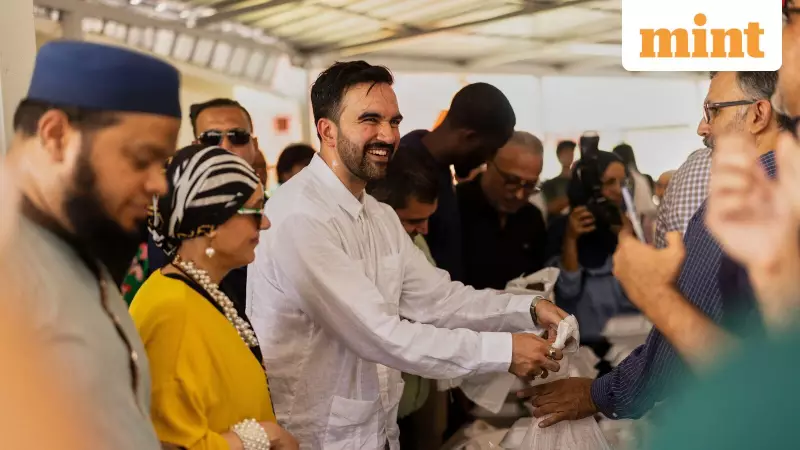
In a stunning political upset that has sent shockwaves through American politics, 34-year-old Uganda-born Indian-origin socialist Zohran Mamdani has been elected as the new mayor of New York City. His victory represents a dramatic shift in the political landscape of the city where former President Donald Trump built his real estate empire.
A Political Earthquake in Trump Territory
The Guardian described Mamdani's victory as "an unashamed democratic socialist winning control of the capital of capitalism," highlighting the extraordinary nature of this political achievement. What makes his win particularly remarkable is that he achieved it against established political heavyweights including former New York governor Andrew Cuomo and Republican Curtis Sliwa.
Mamdani's background breaks multiple barriers in American politics. He is not only the youngest mayor in New York City's history but also a Muslim immigrant leading a city that still bears the deep scars of the 9/11 attacks. His election comes at a time when Trump, who made his mark as a real estate baron in NYC, has been advocating for stricter immigration controls.

The Making of a Political Disruptor
When Mamdani entered the mayoral race in 2024, he was largely unknown with limited financial resources and no institutional backing. His rise to power demonstrates the changing dynamics within American politics. His charismatic presence on social media and his alignment with progressive ideals similar to Bernie Sanders helped him connect with a new generation of voters.
Mamdani doesn't shy away from political confrontations. In his fiery victory speech, he directly challenged Trump, declaring: "New York will remain a city of immigrants—a city built by immigrants, powered by immigrants, and, as of tonight, led by an immigrant." He added a powerful warning: "So hear me, President Trump, when I say this: to get to any of us, you will have to get through all of us."
Roots and Political Identity
Mamdani's South Asian heritage played a significant role in his campaign. He is the son of noted filmmaker Mira Nair and Mahmood Mamdani, a Ugandan-born academic of Indian origin. During his victory celebration, he quoted from India's first prime minister Jawaharlal Nehru's famous "Tryst with Destiny" speech and concluded with the Bollywood track Dhoom Machale from the 2004 hit movie Dhoom.
Trump has labeled Mamdani as an extremist, communist, and danger to New York City, reflecting the deep political divisions that Mamdani's election represents. The new mayor-elect has proudly championed left-wing causes including free childcare, expanded public transportation, and increased government intervention in free-market systems.
Broader Implications for Indian-Origin Leaders
Mamdani joins a growing list of Indian-origin politicians achieving high office abroad. In the United States, Kamala Harris served as vice president under Joe Biden and was Trump's Democratic challenger in the 2024 elections. Republicans Bobby Jindal and Nikki Haley have also made their mark in American politics.
Across the Atlantic, Rishi Sunak served as British prime minister while Leo Varadkar held the position of Irish prime minister. This week also saw other significant victories for Indian-origin Americans. Hyderabad-born Senator Ghazala Hashmi became lieutenant governor of Virginia, making her the first Muslim American woman elected to statewide office in the US. Meanwhile, Aftab Pureval won re-election as mayor of Cincinnati, Ohio.
The international response to Mamdani's victory has been cautious, particularly from India. With New Delhi's relationship with Trump on uncertain ground—marked by the absence of a trade deal, Trump's claims of intervening in India-Pakistan conflicts, and warnings over purchasing discounted Russian oil—India appears to be taking a measured approach to congratulating NYC's new mayor-elect.
Mamdani's inauguration on January 1 will mark the beginning of a new political era for New York City, with his management of the "Trump Challenge" likely to determine his political future. His victory represents not just a personal achievement but a significant moment in the ongoing redefinition of American politics in the post-Trump era.