

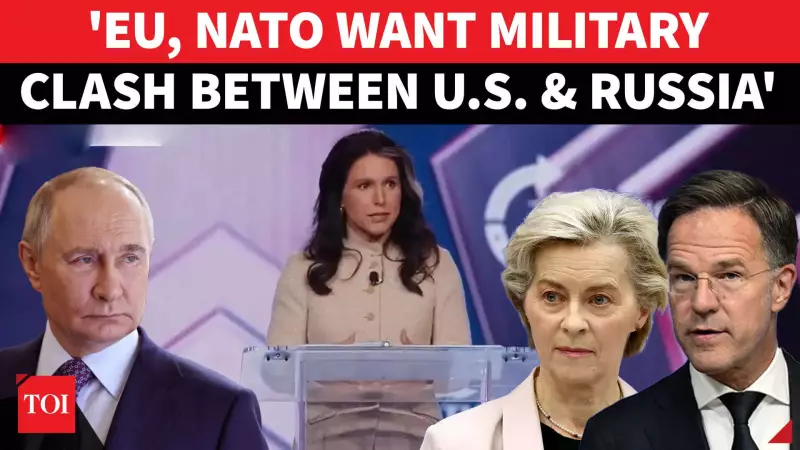
In a fiery speech that has sent shockwaves through diplomatic circles, the United States Director of National Intelligence, Tulsi Gabbard, has launched a stunning public attack on America's closest allies. Gabbard accused the European Union and the NATO military alliance of deliberately pushing the United States towards a direct and catastrophic war with Russia.
A Scathing Accusation at Arms Fest
The controversial remarks were delivered by Gabbard at the Arms Fest event in Arizona on December 21, 2025. Moving beyond typical diplomatic language, the intelligence chief presented a grave assessment of the ongoing Ukraine war's dynamics. She asserted that instead of working to de-escalate tensions and find a peaceful resolution, key European powers within the EU and NATO are actively escalating the situation.
Gabbard's core allegation is that these allies want to see the United States engage in a head-to-head military confrontation with Russia. She claimed their actions are designed to block potential "off-ramps" to peace, thereby prolonging the conflict and increasing the risk of a wider, more dangerous war that would directly involve American forces.

The 'Deep State' Obstruction Claim
Expanding her critique to domestic actors, Gabbard pointed fingers at forces within Washington itself. She alleged that shadowy "Deep State" actors are working behind the scenes to sabotage any potential peace talks or diplomatic solutions between the warring parties.
According to her speech, these unnamed officials and institutions are systematically undermining efforts to bring the war in Ukraine to a negotiated end. This internal obstruction, combined with the alleged provocations from European allies, creates a perfect storm that heightens the risk of a direct U.S.-Russia clash.
Context and Global Repercussions
Gabbard's explosive comments come amid a highly volatile global security environment. The war in Ukraine, now approaching another year, remains a flashpoint with no clear end in sight. The U.S. intelligence chief's decision to "name and shame" traditional allies like the EU and NATO so openly is unprecedented and signals a potentially major shift in Washington's internal foreign policy debates.
The speech directly challenges the official Western narrative of united support for Ukraine. It introduces a public fissure, suggesting that the transatlantic alliance may be deeply divided over the endgame of the conflict. For nations like India, which maintains a delicate balancing act between its relationships with the US, Russia, and Europe, such stark accusations from a senior U.S. official add another layer of complexity to diplomatic calculations.
The immediate consequences of Gabbard's allegations are likely to be significant. They could strain intelligence-sharing and military coordination within NATO, provoke fierce rebuttals from European capitals, and fuel further political debate within the United States about its role in the Ukraine war and its broader strategy towards Russia.






