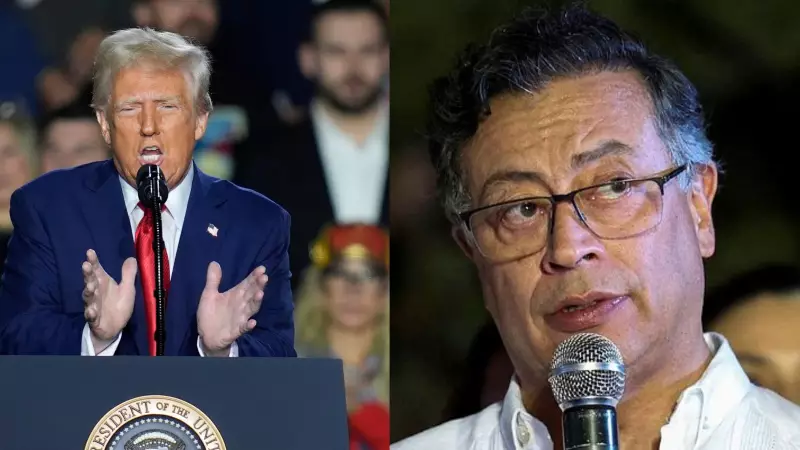
In a dramatic escalation of diplomatic tensions, Colombian President Gustavo Petro has issued a stark warning to the United States, specifically targeting former President Donald Trump. Petro declared that Colombia would respond with its own military force if a future Trump administration ordered US troops to conduct operations on Colombian soil against drug cartels.
A Direct Challenge to Trump's Proposed Policy
The confrontation stems from recent campaign rhetoric by Donald Trump, the presumptive Republican nominee for the 2024 US presidential election. Trump has repeatedly suggested that, if re-elected, he would deploy US military assets to Colombia to "fight the cartels" and "knock them out." He framed this as a necessary measure to stop the flow of drugs into the United States.
President Petro, Colombia's first leftist leader and a former guerrilla, responded with unprecedented bluntness. He stated that any unilateral US military operation in Colombia would be considered a violation of national sovereignty and an act of war. "If Donald Trump dares to touch Colombian soil with his soldiers, we will use our military forces to respond," Petro asserted, framing the potential action as a defense of Colombia's dignity and self-determination.

The Roots of the Dispute: A Clash Over Drug War Strategy
This fiery exchange highlights a fundamental clash in strategies to combat narcotics trafficking. The United States, for decades, has pursued a largely militarized and interdiction-focused approach in Latin America, often providing training and equipment to local forces. Colombia has been a primary partner in this effort under previous governments through initiatives like Plan Colombia.
However, since taking office in August 2022, Gustavo Petro has championed a radical shift. His government advocates for addressing the drug trade as a socioeconomic issue rather than solely a military one. Key pillars of his policy include:
- Substituting illegal coca crops with legal alternatives.
- Focusing on rural development and poverty alleviation.
- Criticizing the global "war on drugs" as a failure that fuels violence.
Trump's proposed plan represents a direct rejection of Petro's vision, reverting to a hardline, external interventionist model that Petro finds unacceptable.
Implications for US-Colombia Relations and Regional Stability
The public spat carries significant weight for bilateral relations and security in the Western Hemisphere. Colombia has long been the United States' closest military and political ally in South America. A breakdown in this partnership would represent a major geopolitical shift.
Analysts suggest Petro's strong statement is aimed at multiple audiences. Domestically, it reinforces his image as a nationalist leader defending Colombia from foreign imposition. Internationally, it signals to other Latin American nations a firm stance against what many in the region perceive as US hegemony and interventionism.
The Biden administration has maintained a more diplomatic, albeit sometimes strained, relationship with Petro, focusing on cooperation on climate change and migration. A potential return of Donald Trump to the White House, however, threatens to plunge the alliance into its most severe crisis in modern history, with the real possibility of a military standoff.
President Petro concluded his remarks by emphasizing dialogue and shared responsibility, but his military threat underscores the high stakes. The situation presents a volatile prelude to the US election, where the outcome in November could directly determine the future of security cooperation between Washington and Bogotá.