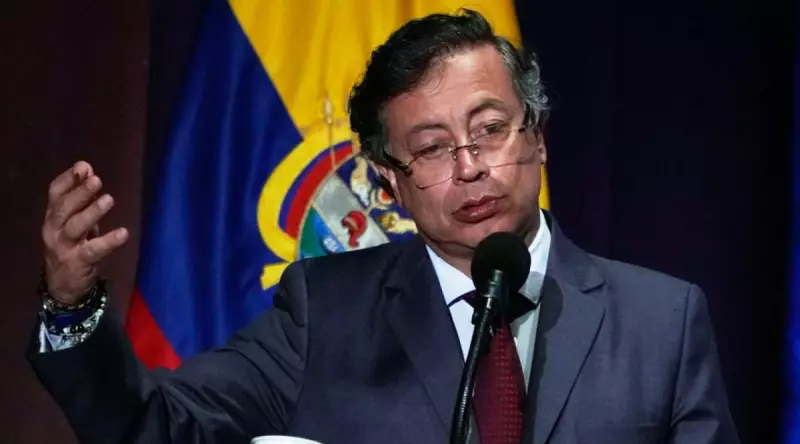
In a dramatic escalation of political rhetoric, Colombian President Gustavo Petro has publicly dared former US President Donald Trump, issuing a challenge that echoes a similar taunt once made by Venezuela's leader. The bold statement, "Come get me, I'm waiting," throws down the gauntlet in a growing war of words that underscores deep-seated tensions in US-Latin American relations.
A Defiant Challenge Echoes Across the Continent
The provocative dare was delivered by President Petro on a prominent social media platform. This move is seen as a direct response to critical comments and threats perceived to be emanating from Trump's camp regarding Petro's leftist government and its policies. The Colombian leader's defiance is not without precedent in the region.
In a striking parallel, Venezuela's President Nicolas Maduro had used the exact same phrase, "Come get me, I'm waiting," to challenge Trump back in 2017. At that time, the US administration had labeled Maduro a "dictator" and imposed severe sanctions, with Trump even mentioning a possible "military option" for Venezuela. Petro's repetition of this phrase consciously links his current standoff with Trump to Maduro's past confrontations, framing it as a broader struggle against US interventionism.

Roots of the Tension: Policy Clashes and Ideological Divides
The friction between Petro and Trump stems from fundamental ideological differences. Gustavo Petro, Colombia's first leftist president, has pursued policies that often clash with traditional US interests in the region. These include his ambitious approach to climate change, efforts to negotiate peace with armed groups, and a more critical stance on the decades-long US-led War on Drugs.
Donald Trump, on the other hand, has historically taken a hardline stance against leftist governments in Latin America, most notably in Venezuela, Cuba, and Nicaragua. His potential return to power in the upcoming US presidential election raises fears in Bogota of a more aggressive and punitive US foreign policy towards Colombia. Petro's dare appears to be a preemptive strike, establishing a position of public resistance ahead of any potential Trump presidency.
The date of this confrontation is significant, occurring on January 6, 2026, a date already etched in political memory for the US Capitol riots. This timing adds a layer of symbolic weight to the exchange, highlighting the ongoing political turmoil that extends beyond US borders.
Implications for Regional Diplomacy and Stability
This public spat has immediate consequences for diplomatic relations between the United States and one of its longest-standing allies in South America. Colombia has traditionally been Washington's closest partner in the region, but Petro's presidency has markedly shifted that dynamic. A heated personal conflict between the two nations' leaders could destabilize cooperation on critical issues like migration, drug trafficking, and trade.
Furthermore, Petro's alignment with Maduro's rhetoric is particularly provocative. It signals a potential realignment in regional politics, where left-leaning governments may unite in opposition to a Trump-led US foreign policy. This could create a more polarized and contentious geopolitical landscape in the Western Hemisphere.
The challenge also resonates domestically in both countries. For Petro, it bolsters his image as a strong, anti-imperialist leader standing up to a powerful external threat. For Trump, it provides fodder for his narrative of a weak US stance abroad under the Biden administration, which he can contrast with his own confrontational style.
As the world watches, this exchange sets the stage for a potentially volatile period in inter-American relations. Whether this remains a war of words or escalates into concrete policy actions will depend heavily on the outcome of the upcoming US election and the strategic calculations in both Bogota and Washington. For now, President Petro's message is clear: he is not backing down, and he is ready for a fight.