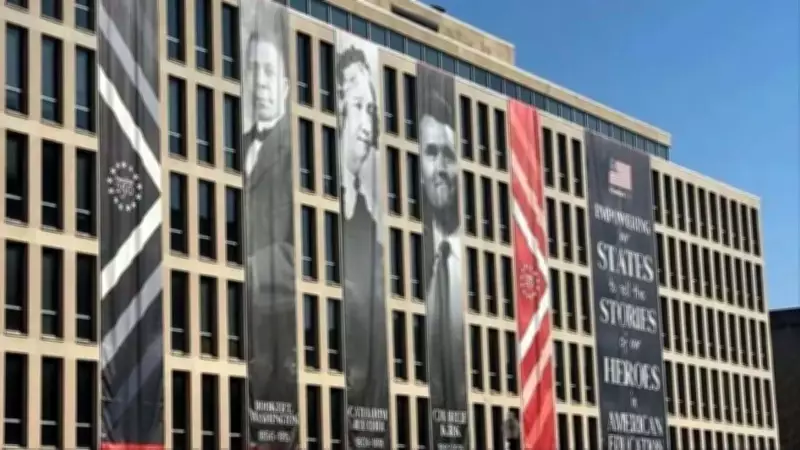
Charlie Kirk Banner at US Education Department Headquarters Ignites Widespread Debate
A large banner featuring the face of slain conservative commentator Charlie Kirk now hangs prominently outside the US Department of Education's headquarters in Washington DC, triggering sharp reactions across social media platforms. The display, installed on March 1, features Kirk alongside banners of historic education figures including Catharine Beecher, Booker T. Washington, Benjamin Franklin, Martin Luther King Jr. and Anne Sullivan.
Controversial Inclusion Among Education Icons
The banners are displayed across the building on Maryland Avenue as part of a broader initiative. One banner reads: "Empowering our States to tell the Stories of our Heroes in American Education." Others reference America's upcoming 250th anniversary, with slogans such as "Recharting the course toward a brighter future for American education" and "Turning the page to the next 250 years of academic excellence."
What makes Kirk's inclusion particularly contentious is his background compared to the other featured figures. While the others had long careers as educators, teachers or academics, Kirk was primarily known as a political commentator and activist.

Who Was Charlie Kirk?
Charlie Kirk, 31, was a co-founder of the conservative non-profit organisation Turning Point USA, which advocates conservative politics among young people, particularly on college campuses. A close ally of former US President Donald Trump, Kirk was shot and killed on September 10 while speaking at a campus event at Utah Valley University in Orem, Utah.
A 22-year-old suspect has been charged with aggravated murder and other felonies in connection with his death. Despite his polarising rhetoric, including contentious remarks about the Civil Rights Act of 1964, abortion and gun laws, Trump and his allies have praised Kirk as a "great American hero" and a "martyr" for freedom. In October, Trump posthumously awarded him the Presidential Medal of Freedom.
Department Defends Decision Amid Criticism
In a statement, Education Department press secretary Savannah Newhouse said: "We are proud to honor visionary leaders whose contributions have shaped the future of education for generations. Their work reflects Benjamin Franklin's timeless belief that 'an investment in knowledge pays the best interest.'"
The statement added that as the US marks a historic 250-year milestone, the moment is meant to encourage educational opportunity and inspire future generations.
Netizens Voice Strong Criticism
The banner featuring Kirk has sparked widespread criticism on social media, with many questioning his inclusion on a federal education building. Critics have highlighted several points of contention:
- Kirk dropped out of community college, which some argue makes him an inappropriate choice for an education honor
- He once told a ninth grade girl who asked about studying political journalism to forget about learning because she's going to college to get married
- Kirk had previously called for abolishing the Department of Education, as recently as last year
One X user wrote: "He dropped out of community college. Told a ninth grade girl who asked about studying political journalism to forget about learning because she's going to college to get married. That's the guy that has a banner on the Department of Education?"
Another commented: "He did drop out of community college, so maybe his picture is what not to grow up to be like. Education matters!!"
Broader Political Context
The development comes weeks after a large banner of President Trump's face was unveiled outside the Department of Justice headquarters, signalling what some observers see as an increasingly political tone in federal building displays. As America approaches its 250th anniversary, the Department of Education maintains that the banners are meant to honour figures who shaped educational discourse, though the selection criteria remain a subject of intense debate.

The controversy highlights ongoing tensions about how educational institutions should recognize contributions to American society, particularly when those contributions are intertwined with political activism. The Department of Education's decision to include Kirk alongside traditional education figures has opened discussions about what constitutes an educational hero in contemporary America.