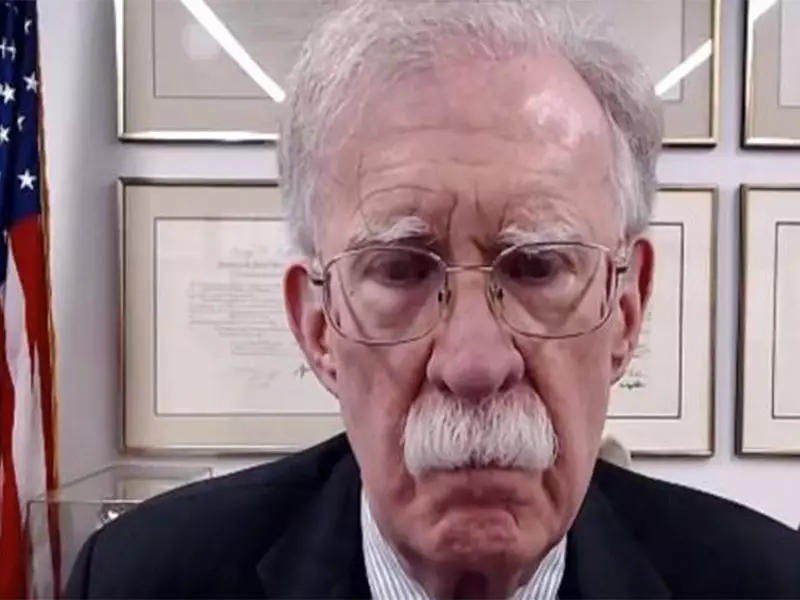
In a stark and provocative statement, former United States National Security Advisor John Bolton has characterised Venezuelan President Nicolás Maduro as the 'rogue leader' of a 'criminal gang' and expressed strong support for efforts to capture him. Bolton's comments come amidst a renewed US focus on the Venezuelan leader, including a substantial financial reward for information leading to his arrest.
Bolton's Blunt Accusation and Support for Capture
John Bolton, who served under the Trump administration, did not mince words in his assessment of the Caracas regime. He explicitly stated that the objective is to go after Maduro, whom he described as the head of a criminal organisation masquerading as a government. 'We're going after a rogue leader of a criminal gang that has stolen the country from the people of Venezuela,' Bolton declared, framing the issue as a matter of justice rather than purely political disagreement.
His remarks underscore a long-held hardline position from Washington, viewing Maduro's presidency as illegitimate. Bolton's advocacy aligns with the US Department of State's ongoing offer of a reward of up to $15 million for information leading to Maduro's arrest and/or conviction. The bounty is linked to charges of narcoterrorism, corruption, and drug trafficking levied against Maduro and his associates by US authorities.

The Geopolitical Context and Legal Charges
The situation is deeply entrenched in complex geopolitical tensions. The United States, along with dozens of other countries, recognised opposition figure Juan Guaidó as Venezuela's legitimate interim president in 2019, a move that Maduro's government, backed by allies like Russia, China, and Cuba, vehemently rejected. Bolton was a key architect of this 'maximum pressure' campaign aimed at ousting Maduro.
The legal basis for the US pursuit rests on indictments from federal courts. Maduro and several high-ranking Venezuelan officials are accused of conspiring to 'flood the United States with cocaine' and using drug trafficking as a weapon against America. These allegations paint a picture of state-sponsored criminality, which Bolton's 'criminal gang' analogy seeks to amplify.
Implications and Regional Repercussions
Bolton's statements are likely to further strain the already fractured relationship between Washington and Caracas. They signal that, despite changes in the US administration, the pursuit of Maduro under these specific charges remains a bipartisan priority in certain powerful circles. The rhetoric also serves to justify continued and potentially intensified economic sanctions on Venezuela's oil and financial sectors.
For the people of Venezuela, enduring a severe economic and humanitarian crisis, such declarations add another layer of uncertainty. While the opposition may welcome the sustained international pressure, the practical path to removing Maduro, who retains control of the military and state institutions, remains fraught. The situation continues to be a flashpoint in Latin American politics and US foreign policy, with Bolton's latest comments ensuring the spotlight stays firmly on the Venezuelan leader.
Ultimately, Bolton's framing of Maduro as a rogue criminal leader rather than a conventional political adversary reflects a fundamental shift in how some in Washington view the conflict. It moves the discourse from diplomatic recognition to one of law enforcement and international justice, setting a precedent with significant global ramifications.