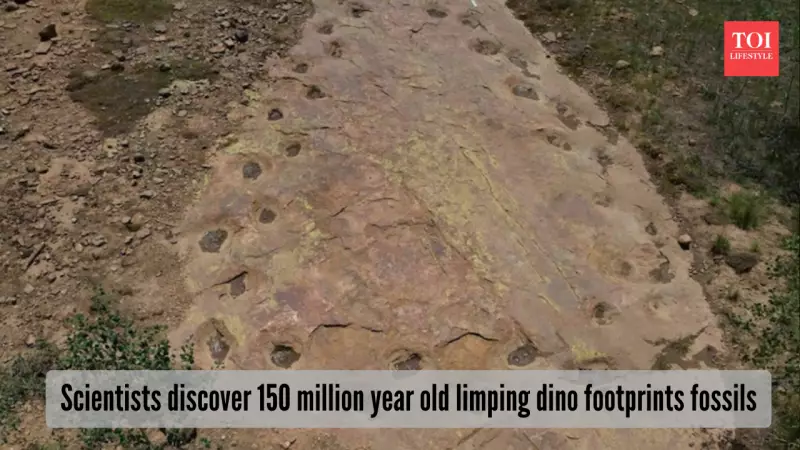
In an extraordinary find that acts like a window into a lost world, scientists have uncovered a prehistoric path walked by a limping giant. A series of over 130 dinosaur footprints, frozen in stone for 150 million years, reveals the painful journey of a massive sauropod in what is now Colorado, USA. This unique trackway provides behavioural clues that fossilised bones alone could never tell.
A Rare Looping Path from the Jurassic
Paleontologists from the University of Queensland have analysed a remarkable trackway stretching over 310 feet (about 94 metres) near the town of Ouray in Colorado. The site contains more than 130 individual footprints made by a long-necked, four-legged sauropod dinosaur. According to a press release from November 25, the pattern of the tracks is exceptionally rare—they form a distinct loop.
University of Queensland paleontologist Anthony Romilio highlighted the trackway's uniqueness. He stated that while turning trackways are rare, "trackways that loop, well, there are only two known in the world, the one in Colorado and one in China." He further noted that a rockslide destroyed the Chinese site, making the Colorado loop the only one of its kind surviving today.

Clear Evidence of an Ancient Limp
The detailed analysis of the footprints has provided compelling evidence of the dinosaur's condition. Measurements from the 130-plus prints show a statistically significant difference between the steps taken by its left and right legs, indicating a pronounced limp.
"By assessing the difference between the steps made with the left leg versus those from the right, we found there was a statistically significant difference," explained Romilio. He added that while the limp is clear, the exact cause remains speculative. "Whether that was due to a prior injury resulting in a persistent limp and simply having a preference for one side over the other is speculation. We'd need a time machine to know for sure."
The dinosaur could have been a Camarasaurus, which had deeper front footprints ("front-wheel drive"), or a Diplodocus, which had deeper hind prints ("rear-wheel drive"). Both species were common in the Jurassic period in this region.
Footprints: A Snapshot of Living Behaviour
Unlike bones, which can be moved after death, footprints are a direct record of a living animal's movement. This makes them invaluable for understanding dinosaur behaviour. Romilio emphasised that long trackways like this one allow scientists to perform robust statistical analyses on the creature's gait.
The reason for the unusual looping path is a topic of intrigue. While avoiding predators like Allosaurus is a compelling theory, Romilio cautioned that it is unproven. "It is difficult to determine whether other dinosaurs were present at the time. As paleontologists, we work carefully within the bounds of the evidence... the idea that the trackmaker might have been avoiding something is certainly a compelling speculative interpretation," he said.
The discovery also highlights the vital role of local communities in paleontology. "The looping trackway has been known to residents since the mid-1950s," Romilio noted. "It was accessible, frequently visited, and quietly appreciated long before it entered scientific discourse." Formal scientific study began only around five years ago.
This fascinating find adds to a series of significant dinosaur discoveries in 2025, continuing to fuel global interest in these ancient giants and the secrets they left imprinted on the Earth.