UN Chief Advocates for Multipolar Global Framework, Cites India-EU Trade Deal as Key Example
In a significant address outlining his priorities for 2026, United Nations Secretary-General Antonio Guterres has strongly advocated for the establishment of a multipolar world order. He emphasized that complex global issues cannot be resolved by a single dominant power or through the persistent rivalries between major nations like the United States and China.
Beyond Bipolar Rivalries: The Case for Collaborative Networks
Guterres stressed that the path to sustainable global stability lies in fostering robust, interconnected networks. He highlighted critical areas such as international trade, technological collaboration, and diplomatic cooperation as foundational pillars. "One power or two powers can't solve the world's problems," he stated, underscoring the limitations of a bipolar or unipolar approach to governance.
To illustrate his vision, the UN chief pointed to several landmark international agreements that exemplify this collaborative spirit:

- The EU-Mercosur trade agreement
- The EU-Indonesia comprehensive economic partnership
- The Canada-China trade framework
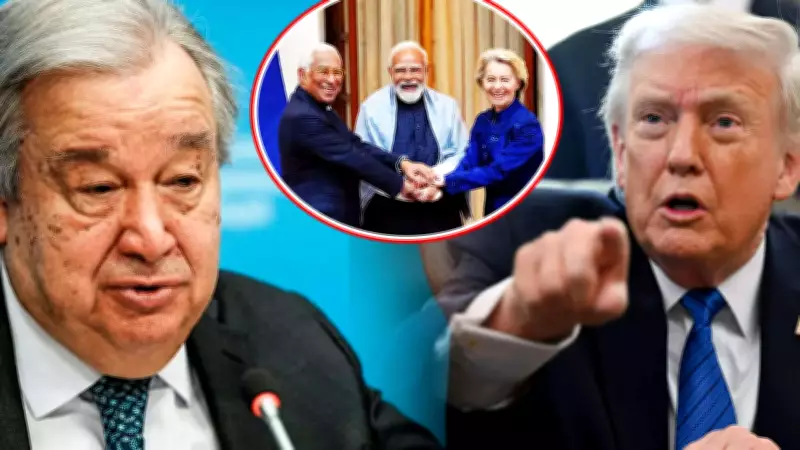
- The landmark India-EU Free Trade Agreement (FTA)
The "Mother of All Deals": India-EU FTA as a Paradigm Shift
Particular attention was given to the India-EU Free Trade Agreement, which Guterres described as transformative. Termed the "mother of all deals," this ambitious pact aims to create an integrated market encompassing over two billion people. The agreement is designed to significantly advance:
- Bilateral Trade: Removing barriers and boosting economic exchange between two major economic blocs.
- Defense Collaboration: Enhancing strategic and security partnerships.
- Rules-Based Order: Strengthening international law and multilateral governance structures.
During the recent summit, India and the European Union solidified this partnership further by signing additional accords focused on security cooperation, defense collaboration, and facilitating the mobility of Indian skilled professionals to Europe.
Building Inclusive Structures for a Sustainable Future
Guterres elaborated that such inclusive, multi-polar frameworks are not merely economic arrangements but are essential for building resilient multilateral institutions. He connected this directly to broader UN goals, stating that multipolarity is crucial for achieving sustainable development and promoting the universal values enshrined in the UN Charter.
The Secretary-General's remarks position multipolarity not as a fragmentation of power, but as a necessary evolution towards a more balanced, cooperative, and stable international system where diverse nations contribute to shared solutions.