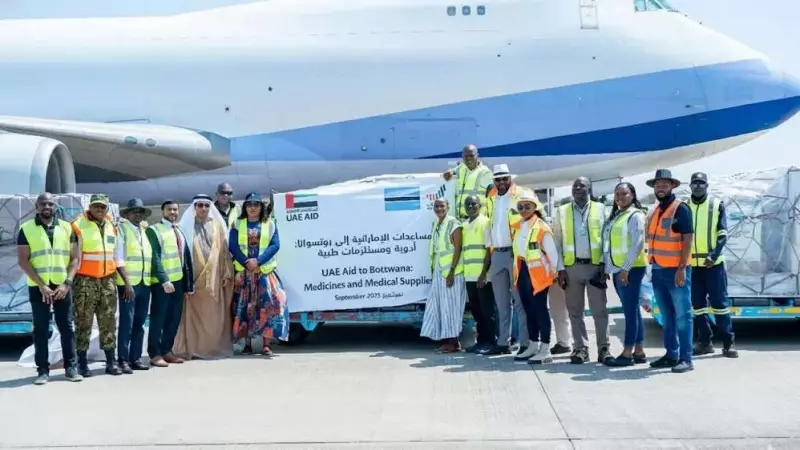
In 2025, the United Arab Emirates (UAE) solidified its position as one of the world's foremost providers of humanitarian assistance, delivering critical financial support, emergency relief, and sustainable development aid to populations grappling with war, displacement, hunger, and natural disasters. The global community widely acknowledged these efforts, highlighting the nation's enduring dedication to improving human welfare internationally.
UAE Among Top Three Global Donors
Data released by the United Nations Office for the Coordination of Humanitarian Affairs (UNOCHA) confirmed the UAE as the third-largest contributor of humanitarian aid globally in 2025. The Emirates provided a substantial $1.46 billion, accounting for roughly 7.2% of all international aid recorded that year. This placed the nation behind only the United States and the European Union in total contributions.
Sheikh Theyab bin Mohamed bin Zayed Al Nahyan, Deputy Chairman of the Presidential Court for Development and Fallen Heroes' Affairs, stated that this ranking mirrors the UAE's unwavering commitment to humanitarian action. He emphasized that this work is driven by core values of empathy, collaboration, and unity. This annual contribution is part of a far more extensive legacy. Since initiating worldwide humanitarian operations decades ago, the UAE has reportedly disbursed more than Dh370 billion (around $100 billion) in assistance, impacting over one billion individuals across 200 countries.

Major Relief Operations in Gaza and Sudan
The UAE's aid played a crucial role in regions experiencing severe conflict and famine. Its response to the crisis in Gaza stood out as one of the planet's most significant relief campaigns, with total aid valued at $2.57 billion. This multifaceted operation extended beyond monetary donations to include direct, on-ground support.
Healthcare Support: The nation set up a field hospital within Gaza that provided treatment to over 53,000 patients. Additionally, a floating hospital stationed in Egypt cared for nearly 21,000 individuals.
Food Security: Through the operation of 20 bakeries, the UAE produced enough bread daily for 76,000 people. Furthermore, 50 community kitchens distributed meals to 286,000 people every day.
Water Provision: The deployment of six desalination plants ensured a daily supply of two million gallons of fresh water, serving approximately one million residents.
Concurrently, the UAE continued as a principal supporter of the Sudanese people. Since the conflict began in 2023, the Emirates has supplied $784 million in aid, making it the second-largest donor to Sudan worldwide. In December 2025 alone, the country allocated an extra $15 million to the UNHCR to help refugees and displaced persons. This brought its total aid to Sudan over a ten-year period to more than $4.24 billion.
Addressing Global Water Scarcity and Local Needs
Beyond urgent conflict response, the UAE launched a significant initiative to combat the growing global water crisis. Through the Mohamed bin Zayed Water Initiative (MBZWI), the country led international endeavors to tackle the reality that four billion people currently face water shortages.
In collaboration with the World Bank, the UAE organized high-level discussions during the 80th UN General Assembly to expand the use of water reuse technologies. The initiative promotes a paradigm shift to view used water as a valuable resource. To foster innovation, the UAE also supported the $119 million XPRIZE for Water Scarcity, which seeks to develop more cost-effective and accessible desalination solutions for vulnerable urban areas globally.

While the federal government manages large-scale crises, regional bodies like Sharjah Charity International (SCI) execute targeted projects. In a new program launched in December 2025, SCI unveiled a Dh1.1 million project to construct a modern school in Kenya. This initiative aims to transform the lives of children in remote rural areas who currently study in poor conditions or travel long distances.
The new school will feature:
- 12 fully equipped classrooms offering a secure and conducive learning environment.
- A capacity for 480 students, helping to alleviate overcrowding and improve educational quality.
Mohammed Ibrahim bin Nassar, SCI's Director of Corporate Communication, described the project as meeting an "urgent educational need." In 2025, Sharjah Charity assisted over 1.3 million beneficiaries worldwide, including funding life-saving heart surgeries for children in nations like Bangladesh.
A Forward-Looking Pledge for 2026
As 2025 concluded, the UAE demonstrated its ongoing commitment by pledging $550 million to the UN's Global Humanitarian Overview for 2026. This substantial pledge is intended to safeguard the lives of 87 million people anticipated to face acute crises in the coming year.
Reem bint Ebrahim Al Hashimy, Minister of State for International Cooperation, stressed that this support stems from a "profound belief in the necessity of international solidarity." This proactive approach ensures the UAE's humanitarian leadership remains steadfast. Whether responding to a cholera outbreak in Chad, arranging medical evacuations for Palestinian cancer patients, or delivering earthquake relief to distant countries, the UAE has consistently shown that humanitarian action is integral to its national identity.