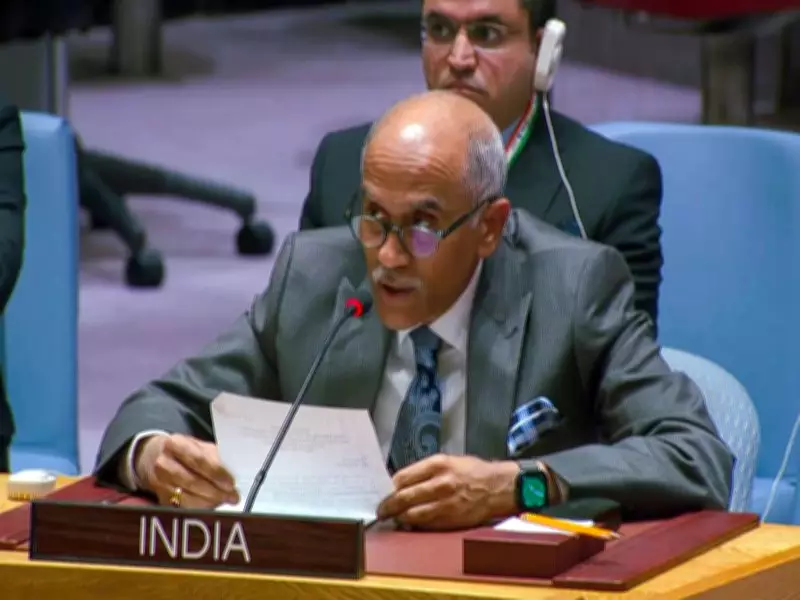
India's UN Envoy Advocates for Universal Fight Against Religious Discrimination
India's Permanent Representative to the United Nations, Ambassador Harish Parvathaneni, delivered a powerful address on Monday, emphasizing the need for a comprehensive global strategy to combat religious discrimination. Speaking at an event marking the International Day to Combat Islamophobia, jointly organized by the Organisation of Islamic Cooperation (OIC) and the United Nations Alliance of Civilisations (UNAOC), Parvathaneni stressed that violence and hatred perpetrated in the name of any religion must be unequivocally condemned.
Condemnation of Religious Violence and India's Secular Tradition
In his statement, Parvathaneni declared, "My delegation strongly condemns violence and hatred in the name of religion, regardless of the religion under question." He extended greetings for the holy month of Ramadan while joining UN members in commemorating the observance. The ambassador highlighted India's rich religious diversity, noting that the country is home to followers of nearly every major religion and serves as the birthplace of Hinduism, Buddhism, Jainism, and Sikhism.
He underscored that India, more than any other nation, is acutely aware of the necessity for a world free from religious discrimination. The philosophy of "Sarva Dharma Sambhava," meaning equal respect for all religions, has profoundly shaped the secular ethos embedded in the Indian Constitution, fostering a tradition of peaceful coexistence.

Warning Against Politicization of Religion
Parvathaneni issued a cautionary note on the dangers of politicizing religion, warning that such actions risk deepening societal divisions rather than resolving grievances. "History bears repeated witness to how the politicization of religion does not solve and resolve grievances; however well-intentioned, they risk lending legitimacy to precisely this kind of selective, polarizing narratives that breed further division," he stated.
He urged the United Nations to approach religious intolerance through a universal framework, rather than focusing narrowly on one specific form. The envoy emphasized that the UN was established to transcend religious and political differences and must maintain its credibility through impartiality. He pointed to the 1981 UN Declaration on the Elimination of All Forms of Intolerance and of Discrimination Based on Religion or Belief as a balanced framework designed to protect the rights of followers of all faiths.
Critique of Pakistan and Defense of India's Muslim Community
In a pointed critique, Parvathaneni indirectly referenced India's western neighbor, Pakistan, accusing it of fabricating narratives about Islamophobia. "India's western neighbour is an excellent example of fabricating imaginative tales of Islamophobia in their neighbourhood," he remarked. He questioned how actions such as the repression of the Ahmadiyya community, the alleged refoulement of Afghan refugees, and military operations during Ramadan would be characterized.
Parvathaneni highlighted that India is home to more than 200 million Muslims, one of the largest Muslim populations globally, and emphasized their full participation in the country's democratic processes. "Muslims in India, including those in Jammu and Kashmir, elect their own representatives to speak for them," he asserted. He argued that narratives portraying India as hostile to Muslims contradict the nation's multicultural traditions, stating, "The only 'phobia' evident here appears to be directed against the multicultural and peaceful coexistence that all communities in India enjoy, including Muslim communities."
Reaffirmation of Commitment to Global Religious Harmony
Concluding his address, the Indian envoy reaffirmed India's steadfast commitment to combating religious intolerance on a global scale. "India reaffirms its commitment to a world free from religious hatred and violence, in all its forms," he declared. He urged the United Nations to focus its efforts on building inclusive societies grounded in equality, dignity, and the rule of law for people of all faiths.

This call for a broader, more inclusive approach underscores India's role as a vocal advocate for religious harmony and its dedication to fostering a global environment where diversity is celebrated and protected.