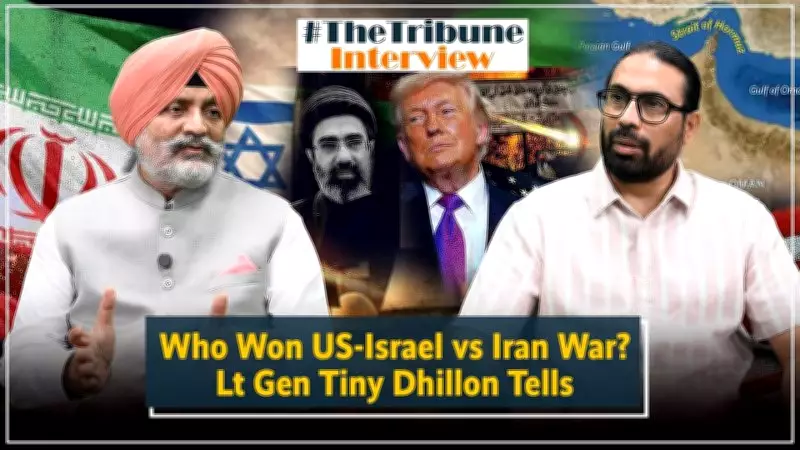
In an exclusive interview with The Tribune, Deputy Editor Jupinderjit Singh spoke with Lt Gen KJS Dhillon (retd) about the US-Iran war, the role of Israel, and why the United States did not select India as a mediator. Dhillon, a strategic affairs expert and author of three books on military operations, is set to release his fourth book on the US-Israel-Iran conflict.
Why the US Chose Oman and Qatar Over India
According to Dhillon, the US opted for Oman and Qatar as mediators because of their established diplomatic channels with Tehran. "Oman and Qatar have maintained open lines with Iran for decades, making them more effective intermediaries," he said. India, despite its strong ties with both the US and Iran, was not chosen due to its complex relationship with Israel and its balancing act in West Asia.
India's Neutrality as a Double-Edged Sword
Dhillon noted that India's position of strategic autonomy, while respected, may have been seen as too neutral for the US in a conflict requiring a mediator with clear alignment. "India has good relations with Iran, the US, and Israel, but that very neutrality can be a drawback when one side wants a mediator that leans towards its interests," he explained.

The Role of Israel in the Conflict
The interview also delved into Israel's involvement. Dhillon stated that Israel played a significant role in pushing the US towards war with Iran, citing intelligence sharing and diplomatic pressure. "Israel views Iran as an existential threat and has been advocating for a tougher US stance for years," he said.
Geopolitical Implications for India
Dhillon emphasized that India's exclusion from mediation does not diminish its global standing. "India remains a key player in West Asia, but this conflict required a mediator with fewer competing interests," he said. He added that India's focus should be on protecting its energy security and diaspora in the region.