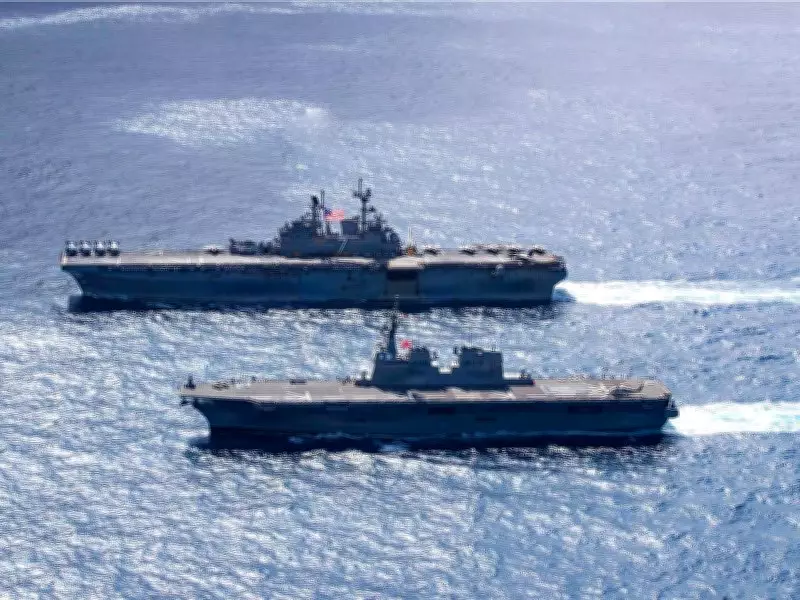
US Military Bolsters Presence in West Asia with USS Tripoli Deployment
In a significant move amid escalating regional tensions, the United States is dispatching a formidable amphibious Ready Group (ARG) led by the USS Tripoli to West Asia. This deployment, which includes approximately 2,500 Marines from the 31st Marine Expeditionary Unit (MEU), comes as hostilities with Iran intensify around the strategically vital Strait of Hormuz.
Strategic Deployment Amid Rising Hostilities
According to reports from Fox News, citing a defense official, the Pentagon has ordered the USS Tripoli ARG to relocate from its current base in Japan to the US Central Command's (USCENTCOM) Area of Responsibility in West Asia. The strike group is anticipated to arrive within one to two weeks, joining an already substantial American military presence in the region. More than 50,000 US troops are currently operational across West Asia, as noted by the New York Times, underscoring the scale of US involvement.
The decision to deploy this strike group follows a series of recent attacks near the Strait of Hormuz that have been linked to Iran. These incidents have disrupted maritime traffic through one of the world's most crucial energy corridors, raising global security concerns. The Strait of Hormuz connects the Persian Gulf with the northern Arabian Sea and is a linchpin for global oil supplies, with around one-fifth of the world's oil transported via this route on large commercial tankers.

Composition and Capabilities of the USS Tripoli Strike Group
The USS Tripoli Expeditionary Strike Group, operating under the US Seventh Fleet, is a powerful naval force designed for amphibious operations. Its composition includes:
- The USS Tripoli amphibious assault ship
- The guided missile cruiser USS Robert Smalls
- The destroyer USS Rafael Peralta
- The 31st Marine Expeditionary Unit
The USS Tripoli itself is one of the largest amphibious assault ships in the US Navy, nearly matching the size of an aircraft carrier. It boasts impressive capabilities, such as:
- Carrying dozens of helicopters, MV-22 Osprey aircraft, and F-35B Joint Strike Fighter jets
- Accommodating over 1,700 Marines along with their equipment
- Operating close to shore to support amphibious landings via landing craft and aircraft
Geopolitical Context and Escalating Tensions
The deployment occurs against a backdrop of heightened geopolitical friction. Recent security concerns have already impacted oil shipments in the region, with tanker traffic slowing after strikes by the United States and Israel against Iran in late February. Iran's southern coastline runs along the Strait of Hormuz, and its authorities frequently contact ships via maritime radio as they enter or exit the Gulf, adding to the strategic complexity.
In a strongly worded statement, US President Donald Trump labeled Tehran's leadership as "deranged scumbags" and asserted that it would be a "great honour" to eliminate them. He further emphasized that Washington is conducting operations to "destroy the terrorist regime of Iran" through military means, signaling a hardline stance as the conflict enters its second week with ongoing exchanges of projectiles.
This move by the US military highlights the critical importance of the Strait of Hormuz in global energy security and the escalating risks of regional conflict. The deployment of the USS Tripoli strike group aims to bolster US deterrence and operational readiness in a volatile environment, where any further incidents could have far-reaching implications for international trade and stability.