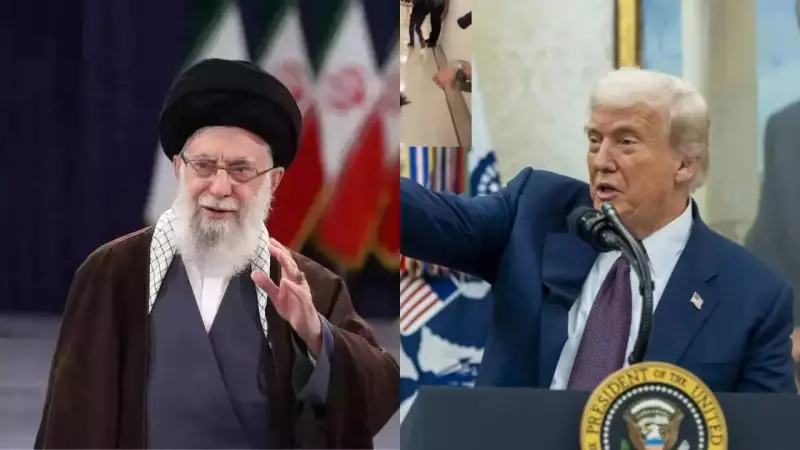
Iran's government is grappling with a new wave of nationwide protests, a situation made significantly more complex by threats from former US President Donald Trump and a severe, ongoing economic crisis. According to officials and insiders, Tehran's attempts to suppress the demonstrations are being hampered by these twin pressures, leaving the leadership with limited and risky options.
Trump's Threats and a Narrowing Path
Following a threat of military action from Donald Trump, Iran's Supreme National Security Council convened a late-night emergency meeting on Friday. The agenda was to strategize on containing the protests with reduced violence and to prepare for potential strikes. Three Iranian officials familiar with the government's deliberations confirmed this to The New York Times.
The officials revealed that Tehran's room for manoeuvre is severely constrained. One official told Reuters that the combination of public anger on the streets and hardening demands from Washington has created a high-stakes dilemma for Iran's leaders. This view was supported by two other current officials and a former official still connected to decision-makers.

The capture of Venezuela's Nicolás Maduro by the US has heightened fears in Tehran. A second Iranian official expressed concern that Iran could become "the next victim of Trump's aggressive foreign policy." Trump further escalated tensions on Friday by threatening to intervene if protesters faced violence, declaring, "We are locked and loaded and ready to go," though he provided no specific details.
Protests Evolve from Economic Grievances
The latest protests, which erupted in Tehran and spread to several western and southern cities, began with a focus on the economy but quickly broadened. While not matching the scale of the 2022-23 unrest triggered by Mahsa Amini's death, the new demonstrations saw some participants chanting "Down with the Islamic Republic" and "Death to the dictator"—a clear reference to Supreme Leader Ayatollah Ali Khamenei.
This shift presents a direct challenge to the authorities, who had been trying to foster national unity after the Israeli-US strikes in June. The economic roots of the anger, however, remain deep. Iran's rial has been in freefall, losing roughly half its value against the dollar in 2025, while official inflation hit 42.5% in December. Years of US sanctions and the aftermath of the June strikes, which targeted nuclear sites, have hammered the economy.
In a bid to address public frustration, the government announced a measure starting January 10: a monthly stipend of 10 million rials per person (about Rs 580) in non-cashable electronic credit for groceries. For low-income households, this offers a modest relief. President Masoud Pezeshkian also urged dialogue and promised monetary reforms.
Security Response and Regional Fallout
Authorities have adopted a dual approach, labelling protests over the economy as legitimate and open to dialogue, while meeting other demonstrations with tear gas and force. Violent street confrontations have occurred. Rights groups reported that at least 17 people were killed in a week, while authorities stated that at least two security personnel died and over a dozen were injured.
Supreme Leader Khamenei, whose priority is preserving the Islamic Republic, accused "enemies of the Islamic Republic" of fomenting the unrest on Saturday and warned that "rioters should be put in their place." Witnesses in Tehran, Mashhad, and Tabriz reported a heavy security presence in main squares.
The backdrop to this crisis includes the stalled nuclear negotiations with the US, which were derailed by the June conflict. The 2025 Israeli-US strikes, which killed top Revolutionary Guard commanders and nuclear scientists, occurred just a day before a planned sixth round of talks. Iran continues to deny Western accusations that its nuclear programme is aimed at developing weapons, insisting its ambitions are peaceful.

Iran's Foreign Ministry spokesperson, Esmaeil Baghaei, condemned Trump's statements, calling them "incitement to violence, incitement to terrorism, and incitement to killing" under international norms. Tehran also condemned Washington's actions in Caracas, highlighting its alliance with Venezuela, another oil producer suffering under US sanctions.