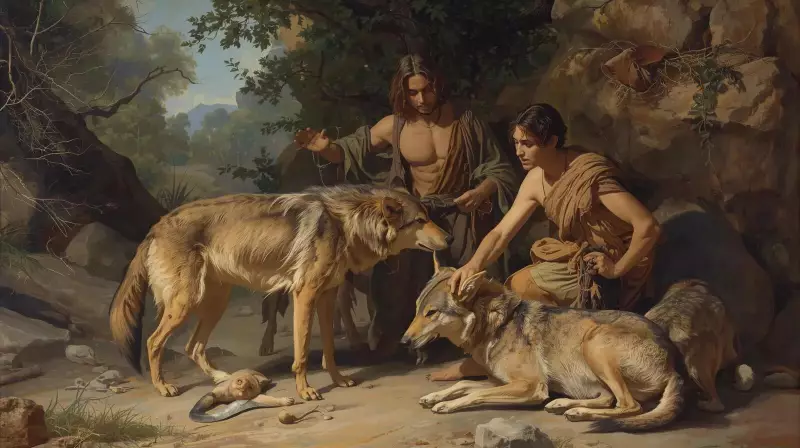
Deep within a low, dark cave carved into limestone on a windswept Baltic island, archaeologists have unearthed a discovery that rewrites a chapter of our ancient past. On Stora Karlsö, a tiny island near Gotland, researchers found the remains of two wolves that lived alongside humans thousands of years ago, pointing to a complex and possibly caring relationship long before the modern dog was fully formed.
A Mysterious Discovery on a Secluded Island
The findings, detailed in the prestigious journal Proceedings of the National Academy of Sciences, come from an island barely 2.5 square kilometres in size. Stora Karlsö has no native land mammals, meaning every animal bone found there tells a story of human intervention. The wolf remains were discovered in layers dating back to the Late Neolithic and Bronze Ages, between 3,000 and 5,000 years ago, when humans visited the island to hunt seals and fish.
The very presence of wolves on the island is the first major clue. Wolves could not have reached Stora Karlsö on their own; there were no land bridges. The inescapable conclusion is that humans deliberately brought them there by boat. This act of transportation itself hints at a significant bond, moving beyond coincidence to intention.

Not Quite Dogs, But Living with Humans
Genetic analysis revealed a fascinating detail. While the wolves shared ancestry with Eurasian wolves, they showed no genetic link to the lineage of domestic dogs (Canis familiaris). This separates them from the known story of dog domestication, which began at least 15,000 years ago. These were wolves, living with people millennia later, yet outside the direct domestic family tree.
So, how did they live? Stable isotope studies of the bones provided a clear answer: their diet was rich in marine protein. They were eating fish, seals, or seabirds—the same diet as the human hunters on the island. This strongly suggests the wolves were not hunting independently but were fed scraps or shared meals by the human community. Such access typically requires a high degree of tolerance and integration.
Evidence of Care and a Blurred Line
Perhaps the most compelling evidence for a close relationship comes from one wolf's skeleton. It bore a significant injury that would have severely limited its mobility, making hunting nearly impossible in the wild. Yet, the animal survived long enough for the injury to partially heal. Researchers argue that human care is the most plausible explanation for its survival on a resource-limited island.
Adding to the mystery, one wolf's genome showed remarkably low genetic diversity, a trait more common in isolated or managed populations than in wild wolves. While this doesn't prove selective breeding, it raises the possibility that humans were managing these wolves in small, controlled groups.
The researchers are cautious not to label these animals as "tamed" or "domesticated" in the modern sense. Instead, they paint a picture of a nuanced, symbiotic relationship. Ancient people may have captured, transported, and cared for wolves without the goal of turning them into dogs. This discovery blurs the traditional line between wild and domestic, revealing a more intricate and collaborative history between our species.