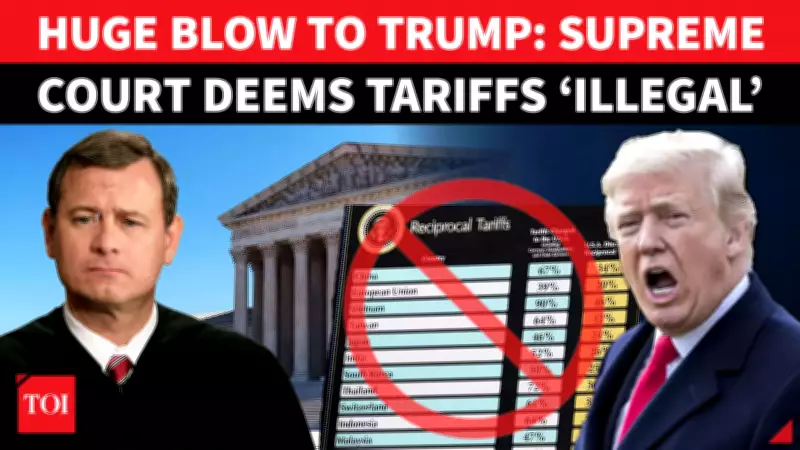
Historic Legal Blow to Trump as Supreme Court Blocks Global Tariffs
In a landmark decision with far-reaching implications, the United States Supreme Court has delivered a significant legal and political setback to President Donald Trump. The court ruled 6-3 that the president exceeded his constitutional authority by imposing sweeping global tariffs using emergency powers.
Court's Ruling and Legal Basis
Chief Justice John Roberts authored the majority opinion, which stated unequivocally that the 1977 law cited by the Trump administration does not authorize unilateral tariff impositions on a global scale. The ruling emphasized that such expansive trade actions require clearer congressional authorization, thereby limiting executive power in international trade matters.
The decision represents a rare judicial check on presidential authority in trade policy, an area where executives have traditionally enjoyed considerable discretion. Legal experts note that this ruling could establish important precedents for future administrations seeking to use emergency powers for economic measures.

Trump's Reaction and Political Fallout
President Trump responded to the ruling with characteristic defiance, calling the Supreme Court decision a "disgrace" and vowing to continue his trade agenda through alternative means. He indicated that he has a backup plan prepared, though details remain unspecified at this time.
The ruling comes at a politically sensitive moment and is likely to fuel ongoing debates about:
- The proper balance between executive and legislative powers
- The scope of presidential authority in international trade
- The role of the judiciary in checking executive overreach
- Future trade policy directions for the United States
Economic Implications and Remaining Tariffs
While the Supreme Court's decision blocks the broadest aspects of Trump's global tariff initiative, some targeted tariffs remain in place under different legal authorities. The ruling nevertheless reshapes the landscape of executive trade power and could have lasting economic consequences.
Economists suggest the decision may:
- Provide greater certainty for international trade partners
- Reduce uncertainty for businesses affected by tariff policies
- Potentially influence future trade negotiations and agreements
- Affect global supply chains that had been disrupted by tariff measures
The full economic impact will likely unfold over coming months as businesses and trading partners adjust to the new legal reality.
Broader Constitutional Significance
Beyond immediate trade policy implications, legal scholars are highlighting the decision's importance for constitutional separation of powers. The 6-3 margin suggests significant judicial consensus on the limits of executive authority in this specific context, though dissenting justices expressed concerns about constraining presidential flexibility in trade matters.
This ruling joins a small but significant body of Supreme Court decisions that have defined the boundaries of presidential power in economic and foreign policy realms. Its effects may extend well beyond the current administration, potentially influencing how future presidents approach trade policy and emergency powers.