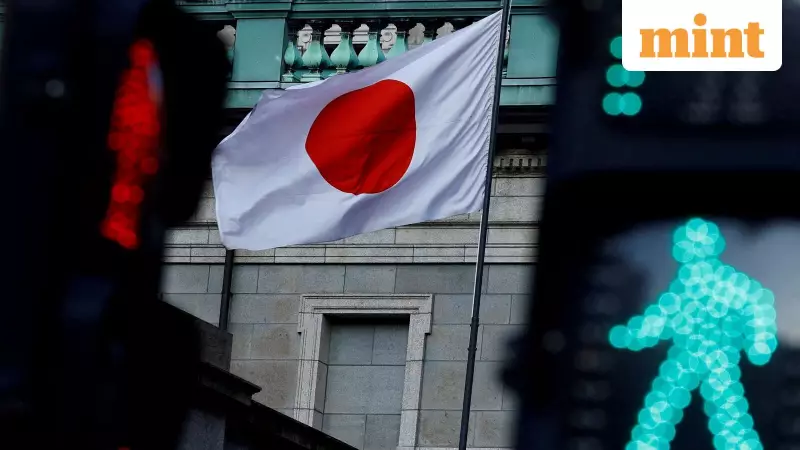
In a historic shift, the Bank of Japan (BOJ) has nudged its benchmark interest rate to a level not seen in three decades. This move marks a cautious but significant step away from its long-standing ultra-loose monetary policy, with potential ripples that could reach Indian shores and affect global financial stability.
The End of an Era: BOJ's Monumental Policy Shift
On Friday, December 19, 2025, the BOJ's rate-setting panel decided to increase its policy rate target to 0.75%, up from the 0.5% level maintained since January. To grasp the scale of this change, consider that the last time Japan's rate was this high was in 1995—the year of O.J. Simpson's acquittal, Coolio's "Gangsta's Paradise," and the first Toy Story film.
The central bank's action is a direct response to persistent inflation, a novel and challenging experience for a nation accustomed to deflation or stagnant prices for years. This stands in stark contrast to the current stance of the U.S. Federal Reserve, which recently cut rates and is considering further reductions amid a softening labor market.

Why a Japanese Rate Hike is a Global Concern
While U.S. investors often overlook foreign central banks, the BOJ is a different story. Frederic Neumann, chief Asia economist at HSBC in Hong Kong, warns that this is not merely a local event. The global impact stems from two key mechanisms: the carry trade and the behavior of Japanese investors.
For years, Japan's near-zero rates made the yen a cheap funding currency for hedge funds and sophisticated investors. They would borrow in yen to buy higher-yielding assets like U.S. Treasurys or stocks—a strategy known as the carry trade. As Japanese rates rise, the yen tends to strengthen, making this trade less profitable. In extreme scenarios, investors might be forced to sell assets to repay yen loans, triggering market volatility. Similar pressures were seen during the 2008-09 financial crisis and in summer 2024 following weak U.S. jobs data.
Potential Ripple Effects: From Tokyo to Wall Street and Beyond
A longer-term consequence involves the massive pool of Japanese capital invested abroad. Years of low returns at home pushed Japanese pension funds, insurers, and retail investors to seek better yields overseas. If rising rates make domestic assets more attractive, these investors might repatriate funds, selling foreign holdings.
Such a shift could depress currencies like the U.S. dollar, pressure global stock prices, and push up borrowing costs for governments and businesses worldwide, including in the U.S. When bond prices fall, their yields rise, directly affecting loan rates for everyday borrowers.
Looking ahead, HSBC's Neumann suggests that if Japanese short-term rates climb to 1-2% over the next few years, the effect on global borrowing costs will be "gradual but perceptible." However, for now, data indicates Japanese investors continue to send money abroad, purchasing a net $102 billion in overseas securities in the year through November.
Economists expect the BOJ to proceed with caution. Stefan Angrick of Moody's Analytics in Tokyo notes the Japanese economy risks losing momentum, suggesting the central bank may find it challenging to raise rates much further from the current level.
While Japanese policy is just one factor influencing global bond yields—others include inflation and growth outlooks—the BOJ's historic pivot away from extreme monetary stimulus is a clear signal that the financial landscape of the past 30 years is changing, with implications for investors and policymakers around the world.