Asian Markets Retreat from Record Highs as Oil Surge and Iran Tensions Weigh on Sentiment
Asian financial markets experienced a notable downturn on Thursday, relinquishing earlier gains that had briefly propelled several indices to record levels. The reversal was primarily driven by escalating geopolitical tensions in the Middle East and a sharp surge in oil prices, which collectively dampened investor confidence across the region.
Japan's Historic Milestone Proves Fleeting as Nikkei 225 Retreats
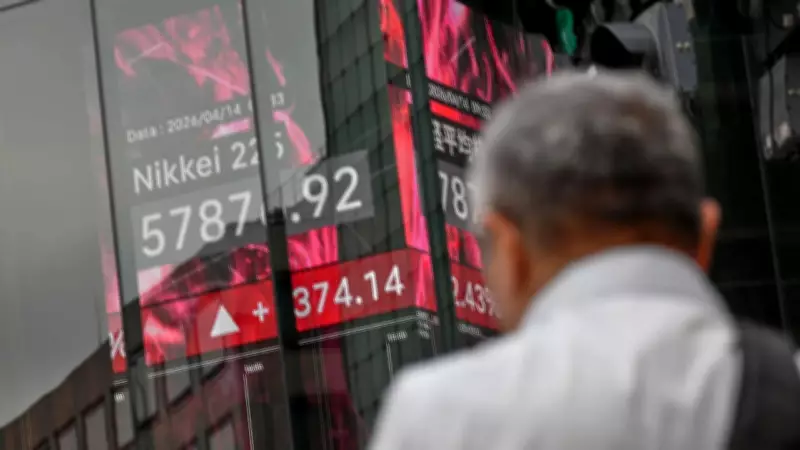
Japan's benchmark Nikkei 225 index achieved a historic milestone by briefly crossing the 60,000 mark for the very first time, reaching an intraday peak of 60,013.98. However, this celebratory moment was short-lived as the index subsequently reversed course dramatically, closing the session with a substantial decline of 1.5% to settle at 58,707.60. This volatility underscored the fragile nature of market optimism in the current geopolitical climate.
Regional Markets Follow Suit with Widespread Declines
The bearish sentiment was not isolated to Japan. Across the Asia-Pacific region, major indices mirrored the downward trajectory. South Korea's Kospi index surrendered its early gains, ultimately slipping 0.1% to close at 6,414.57 after briefly moving above the 6,500 level. Hong Kong's Hang Seng index dropped 1.1% to 25,865.88, while China's Shanghai Composite fell 0.8% to 4,073.71.

The sell-off was broad-based, with Australia's S&P/ASX 200 declining 0.8%, Taiwan's Taiex sinking 1.6%, and India's BSE Sensex closing down 0.6%. This synchronized retreat highlighted the pervasive impact of external macroeconomic and geopolitical factors on regional investor psychology.
Geopolitical Tensions and Oil Price Spike Fuel Market Anxiety
The primary catalyst for the market pullback was the escalating situation in the Middle East, particularly surrounding Iran. Investor mood weakened significantly as hopes for a swift resolution to regional conflicts faded. The uncertainty was compounded by a sharp spike in global oil prices, driven by mounting concerns over potential supply disruptions.
Brent crude futures climbed approximately 1.5% to reach $103.39 per barrel, while US crude oil prices rose 1.8% to $94.66. This represents a significant surge from price levels around $70 per barrel observed prior to the escalation of hostilities in late February. The price increase follows renewed shipping disruptions in the critical Gulf region, including reported seizures of vessels by Iran in the Strait of Hormuz.
The Strait of Hormuz is a vital global energy corridor, typically handling an estimated 20% of worldwide oil flows. Its current operational challenges have forced a recalibration of market expectations. ING strategists Warren Patterson and Ewa Manthey noted that the oil market "is having to reprice expectations," adding that "as hopes fade, the reality of the supply disruption will set in."
Early Optimism Fades Despite Strong Wall Street Lead
Asian markets had initially opened higher, taking cues from a robust rally on Wall Street. US indices had hit record highs, buoyed by strong corporate earnings reports. The S&P 500 rose 1% to 7,137.90, the Nasdaq Composite jumped 1.6%, and the Dow Jones Industrial Average gained 0.7%. Notable performers included GE Vernova, whose shares surged 13.7% following positive earnings, and Boeing, which rose 5.5%.
However, this positive momentum proved unsustainable in Asia. The MSCI's broadest index of Asia-Pacific shares outside Japan fell 0.5% after earlier touching a record high, illustrating how regional-specific risks quickly overshadowed the positive global lead.
Analysts Warn of Persistent 'No-War, No-Peace' Uncertainty
Market analysts emphasized that financial markets remain exceptionally sensitive to geopolitical risks, despite demonstrating resilience in recent weeks. The prevailing environment is characterized by high uncertainty, with peace talks between the United States and Iran remaining inconclusive and ceasefire prospects appearing elusive.

Charu Chanana, a market strategist at Saxo, captured the prevailing mood, stating, "Markets look very on edge here. We are still in a no-war, no-peace zone." She warned that even minor fears of escalation could continue to push oil prices higher and exert downward pressure on risk assets like equities.
Laura Cooper of Nuveen echoed these concerns, highlighting that "the list of risks is growing as resolutions remain elusive." With the fundamental drivers of tension unresolved, investors are likely to maintain a cautious stance, which is expected to keep market volatility elevated across global financial markets in the near term. The interplay between geopolitical developments and commodity prices will continue to be a critical watchpoint for traders and analysts alike.