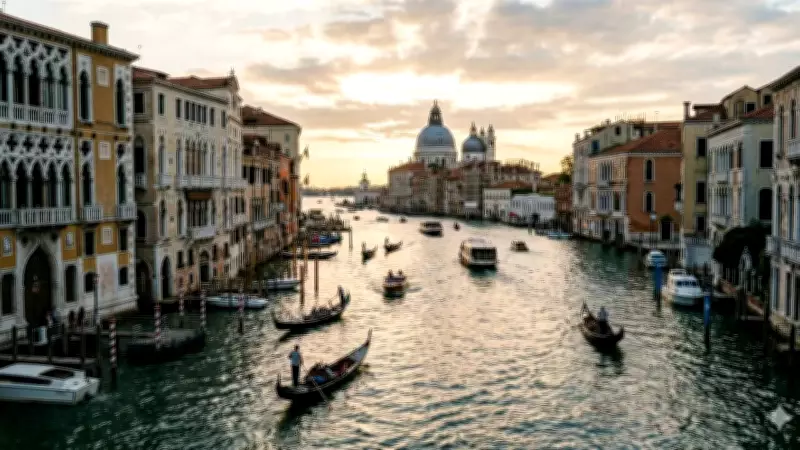
Morning arrives quietly in Venice. Light bounces off canal water instead of glass towers, and footsteps echo through narrow lanes where cars never appear. Delivery boats move through waterways before crowds gather near bridges and squares. Even travellers reaching the city for the first time often notice the same thing immediately: Venice does not behave like a typical European city.
That unusual setting helped create one of its best-known names. Venice is widely recognised as the "Floating City", a nickname linked to its canals, lagoon environment and centuries-long dependence on water. The city developed through a close relationship between people and the wetlands of the Venetian Lagoon, producing an urban landscape unlike conventional mainland settlements. Long before tourism campaigns popularised the phrase, Venice had already become associated with the image of a city rising directly from water.
How Venice became the world-famous Floating City
Venice did not grow beside a river or harbour in the usual sense. It developed within the lagoon itself, across clusters of small islands connected over centuries through bridges, embankments and dense construction. The environment was difficult from the beginning. Marshland shifts constantly. Saltwater slowly damages stone and brick. Foundations weaken over time.

Yet those conditions also provided protection. During periods of invasion and instability in northern Italy after the fall of the Roman Empire, communities gradually settled deeper into the lagoon because it was harder for outside forces to reach. Small island settlements eventually expanded into a functioning city connected almost entirely through waterways.
UNESCO describes Venice as an extraordinary example of human adaptation to demanding environmental conditions, where architecture and water evolved together rather than separately. That relationship still shapes ordinary life today. Boats replace many service vehicles. Public transport moves through canals. Even funeral processions travel across water routes instead of roads.
The phrase "Floating City" emerged from that visual reality, although Venice is not literally floating. Buildings stand on timber piles driven deep into compact sediment beneath the lagoon floor. Large sections of the historic centre remain standing on foundations laid centuries ago.
Reaching Venice: The journey into Italy's Floating City
Part of Venice's reputation comes from the experience of arriving there. Unlike most historic European cities, the transition feels immediate. Roads gradually disappear, canals begin replacing traffic lanes, and boats take over much of the movement through the city.
Most international travellers reach Venice through Venice Marco Polo Airport, located on the mainland north of the historic centre. From there, visitors usually continue by water taxi, vaporetto services or shuttle buses connecting the airport to different parts of the lagoon city. Many travellers also arrive through Venezia Santa Lucia railway station, which sits directly beside the Grand Canal. The railway approach across the lagoon is often the first clear view visitors get of Venice's waterways and tightly packed historic buildings.
For travellers already exploring Italy, Venice is connected by rail with cities such as Rome, Florence and Milan. Walking remains the main way to move around the historic centre itself, although vaporetto water buses continue operating as Venice's public transport network across canals and nearby islands. The unusual arrival experience partly explains why Venice leaves such a strong impression on travellers. Few major cities still function so completely around water.
Exploring the famous sites of Venice's Floating City
Several landmarks remain closely tied to Venice's identity as the Floating City. St. Mark's Basilica is known for its Byzantine-inspired architecture and mosaics, reflecting centuries of eastern influence brought through trade connections. Nearby, Doge's Palace once functioned as the political centre of the Venetian Republic.
Rialto Bridge still crosses one of the busiest stretches of the Grand Canal, where merchants traded goods for generations.
Away from the central district, travellers also visit Murano, historically associated with glassmaking, and Burano, recognised for brightly coloured houses and lace-making traditions.

Gondolas remain part of Venice's international image, although residents rely more heavily on water buses and practical transport boats in daily life. Outside the busiest tourist months, quieter residential canals reveal a slower side of the city, often missing from travel advertisements.
How water shaped Venice and its Floating City identity
Water made Venice wealthy, though it also created constant problems. Trade routes once connected the city to Mediterranean ports and markets farther east, helping Venice become one of Europe's major commercial powers. Merchant wealth financed churches, palaces and civic buildings that still dominate the skyline today.
Flooding, however, never disappeared from daily life. Seasonal high-water events known as acqua alta continue to affect the lower parts of the city. Raised walkways appear across flooded squares, while shopkeepers install temporary barriers outside entrances during particularly high tides.
According to the UNESCO listing, the lagoon itself forms an inseparable part of Venice's identity rather than a simple backdrop. Waterways influenced trade, defence, construction techniques, social organisation and movement through the city. Without the lagoon, Venice would not exist in its present form. That dependence on water partly explains why Venice developed such a lasting international image. Travellers arriving there still encounter a historic urban centre where canals take the place of streets and boats continue functioning as part of everyday life.
The culture and architecture behind Venice's Floating City image
Venetian culture developed under unusual conditions. Space was limited, so buildings rose tightly together along canals and waterfronts. Merchants from different parts of Europe, North Africa and the eastern Mediterranean arrived regularly, bringing foreign goods, languages and artistic influences into the city.
That mixture produced architectural styles uncommon elsewhere in Italy. Byzantine decoration appeared beside Gothic structures and later Renaissance additions. Churches faced canals instead of roads. Public gatherings often unfolded near water rather than open streets or large squares.
Venice also became associated with spectacle and ceremony. Carnival traditions, masked festivals and elaborate maritime processions formed part of public life for centuries. Water itself became woven into political rituals and celebrations.
The image survived because Venice still appears visually unusual even now. Writers, painters and travellers repeated descriptions of the city for generations, reinforcing the idea of Venice as a place suspended between land and water.
About the Author: TOI Lifestyle Desk
The TOI Lifestyle Desk is a dynamic team of dedicated journalists who, with unwavering passion and commitment, sift through the pulse of the nation to curate a vibrant tapestry of lifestyle news for The Times of India readers. At the TOI Lifestyle Desk, we go beyond the obvious, delving into the extraordinary. Consider us your lifestyle companion, providing a daily dose of inspiration and information. Whether you're seeking the latest fashion trends, travel escapades, culinary delights, or wellness tips, the TOI Lifestyle Desk is your one-stop destination for an enriching lifestyle experience.